Book a Demo
Platform Overview
Operations
Operational Impact Deployment & Security Integrations Core Lab Solutions EHR Mining Partnerships
Cardiac Amyloidosis Heart Failure Aortic Stenosis Pulmonary Hypertension Strain Stress Echocardiography
Clinical Evidence Case Studies Testimonials Peer Comparison Authors & Collaborators
For Buying Teams
Regulatory Status Business Case and Pricing ROI Calculator Reimbursements Evaluating AI Echo
News and Reference
News Events Glossary
Our Story Careers Media Kit Patents Trust Center

Clinical Evidence

80 indexed publications on Us2.ai's technology, in journals including The Lancet Digital Health, Nature Communications, JACC and Circulation. Each card marks its type: peer-reviewed paper, conference abstract, or review or editorial.

80
Publications
39
Peer-reviewed papers
32
Journals
538
Contributing authors
80 publications

Publication Library

Peer-reviewed paper Research, not a cleared indication Sep 2026 The International Journal of Cardiovascular Imaging

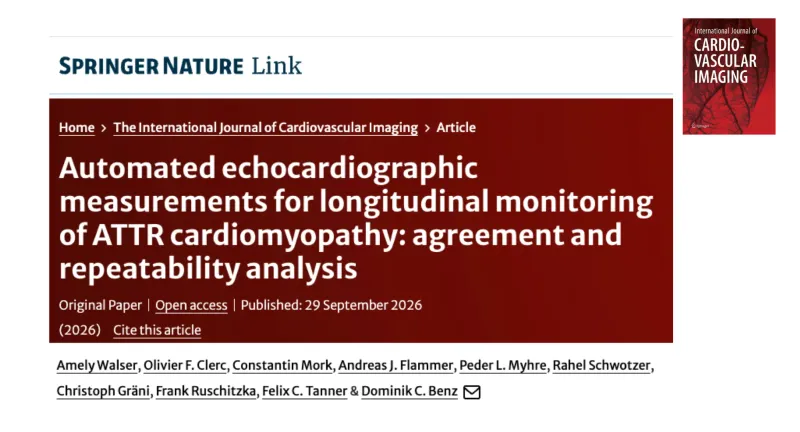
AI Echo for Longitudinal Monitoring of ATTR Cardiomyopathy

Published in the International Journal of Cardiovascular Imaging, this study from University Hospital Zurich demonstrates that Us2.ai-derived echocardiographic measurements show within-study repeatability comparable to that of experienced human readers in patients with ATTR cardiomyopathy, supporting further prospective evaluation of AI-assisted serial echocardiographic assessment in this population.
Conference abstract Research, not a cleared indication Sep 2026

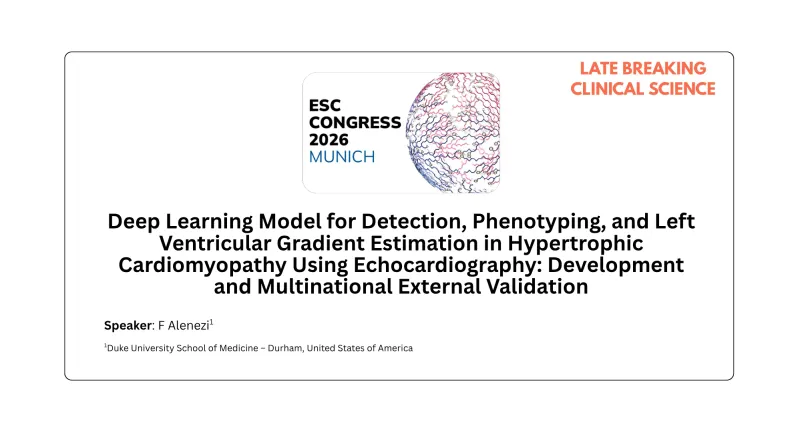
AI Echo is able to Detect HCM, Discriminate Between Phenocopies and Quantify LVOT Obstruction

Presented as a late-breaking clinical science presentation at ESC Congress 2026, this multinational study demonstrates that a fully automated end-to-end deep learning system detects HCM from routine echocardiography with 87.4% external sensitivity, exceeding the published expert benchmark by 37 percentage points, while also discriminating phenocopies and quantifying LVOT obstruction.
Conference abstract Research, not a cleared indication Sep 2026

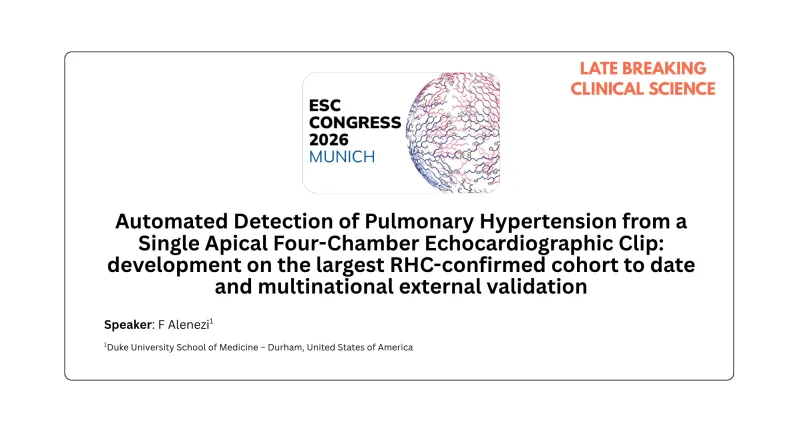
AI Detects Pulmonary Hypertension from a Single Echo Clip

Presented as a late-breaking clinical science presentation at ESC Congress 2026, this multinational study demonstrates that a spatiotemporal transformer trained on the largest RHC-confirmed cohort to date can accurately detect pulmonary hypertension from a single apical four-chamber echocardiographic clip, with no Doppler or multi-view input required, achieving AUROC of up to 0.917 on external validation.
Conference abstract Research, not a cleared indication Sep 2026

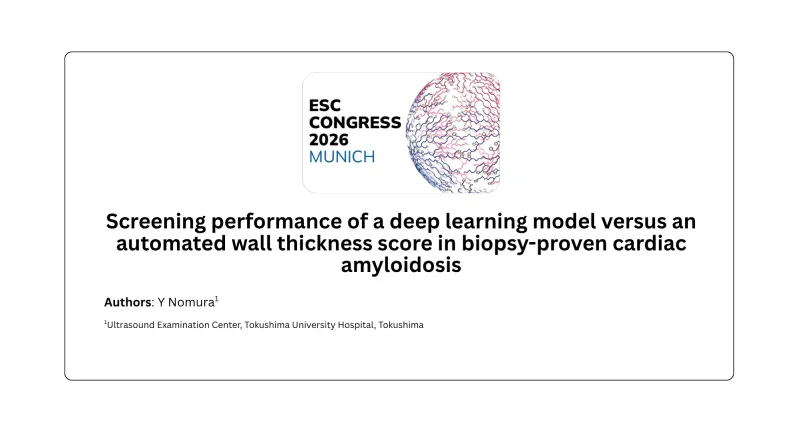
AI Deep Learning Outperforms Wall Thickness Score for Cardiac Amyloidosis Screening

Presented at ESC Congress 2026, this study from Tokushima University Hospital, Japan, demonstrates that the Us2.ai deep learning cardiac amyloidosis detection model achieved 98% sensitivity and a c-index of 0.82, substantially outperforming an automated wall thickness score in a biopsy-proven cohort.
Conference abstract Research, not a cleared indication Sep 2026

AI Echo for Cancer Therapy-Related Cardiac Dysfunction in Breast Cancer: CARE Study

Presented at ESC Congress 2026, this study from the CARE trial at Akershus University Hospital demonstrates that Us2.ai reliably reproduces longitudinal LVEF and GLS trajectories and rules out CTRCD in a large real-world breast cancer cohort, supporting its potential to improve precision and workflow efficiency in cardio-oncology.
Conference abstract Research, not a cleared indication Sep 2026

AI Echo For Cardio-Oncology: Accuracy, Reproducibility and Time Savings

Presented at ESC Congress 2026, this study from Royal Brompton Hospital validates Us2.ai in 384 patients from a dedicated cardio-oncology centre, demonstrating strong agreement with conventional echocardiography, improved interstudy repeatability, and a 43% reduction in study completion time.
Conference abstract Research, not a cleared indication Sep 2026

AI Echo Helps Detect Treatment Response in ATTR Cardiomyopathy Over Time

Presented at ESC Congress 2026, this study from University Hospital Zurich, Bern University Hospital, demonstrates that Us2.ai-powered echocardiography can detect early attenuation of disease progression following disease-modifying therapy in ATTR-CM, supporting its use as a sensitive monitoring tool.
Conference abstract Research, not a cleared indication Sep 2026

AI Echo for Prognostic Risk Stratification in Cardiac Amyloidosis

Presented at ESC Congress 2026, this study from University Hospital Zurich and Bern University Hospital demonstrates that Us2.ai-derived echocardiographic measurements provide robust prognostic stratification in cardiac amyloidosis, with performance comparable to manual measurements and incremental value over biomarker-based staging.
Peer-reviewed paper Research, not a cleared indication Sep 2026 European Heart Journal - Digital Health

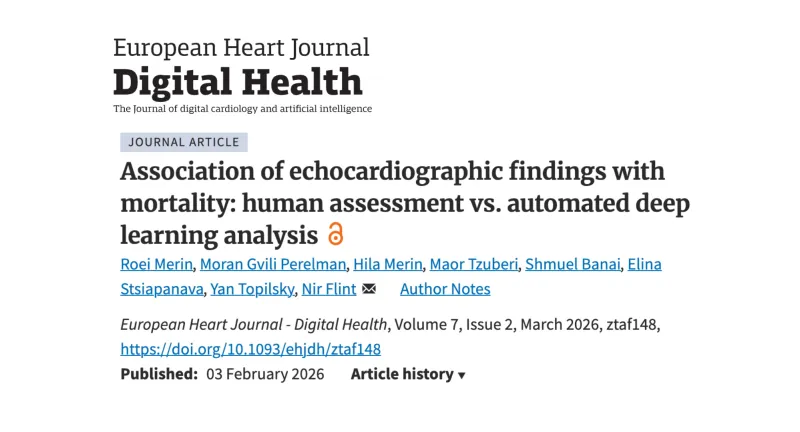
AI Echocardiographic Analysis and Mortality Prediction in Hospitalized Patients

This retrospective study of 889 hospitalized patients demonstrates that Us2.ai-derived echocardiographic measurements are strongly correlated with human expert assessments and comparably predictive of one-year mortality, with AI-derived left ventricular strain analysis providing superior mortality prediction over human assessment alone.
Peer-reviewed paper Aug 2026 Journal of the American Society of Echocardiography

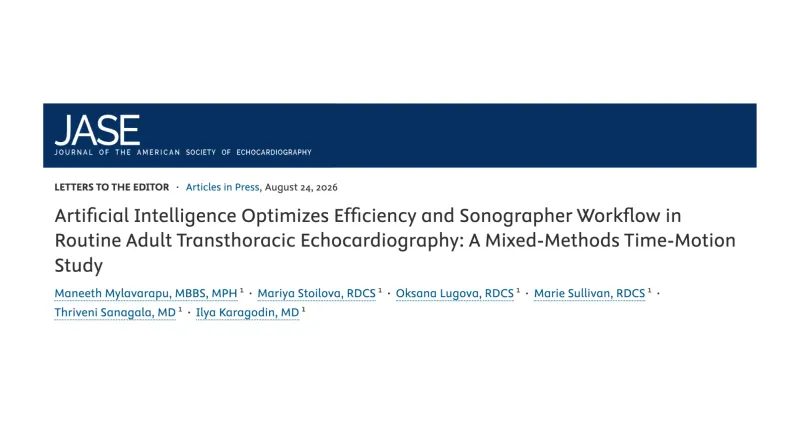
AI Echo Reduces Study Time by 35% in A Real-World Echo Lab

Published in the Journal of the American Society of Echocardiography, this mixed-methods time-motion study from Endeavor Health demonstrates that an AI-driven echocardiography workflow using Us2.ai reduced total study time by 35% across inpatient and outpatient settings, while all participating sonographers reported lower click burden and a preference for future AI adoption.
Peer-reviewed paper Aug 2026 European Heart Journal - Digital Health

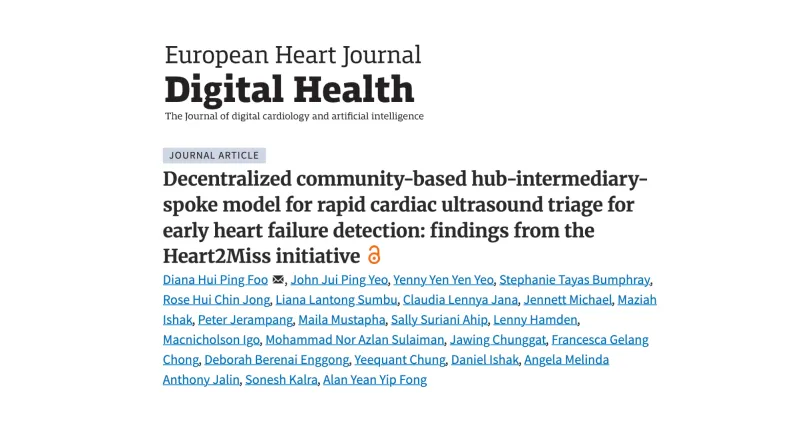
AI Echo for Community Heart Failure Screening: The Heart2Miss Initiative

Published in the European Heart Journal - Digital Health, the Heart2Miss initiative demonstrates that Us2.ai-powered AI-POCUS, operated by novice biomedical graduates after just four weeks of training, can detect previously undiagnosed heart failure in a high-risk diabetes population while reducing tertiary diagnostic burden by nearly 90%.
Conference abstract Aug 2026 Journal of the American Society of Echocardiography

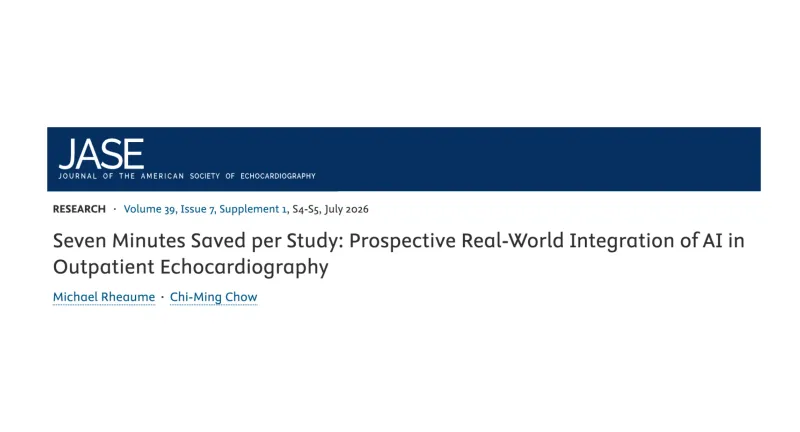
AI Echo Reduces Reporting Time in Outpatient Lab

Presented at the Canadian Society of Echocardiography Echo Weekend 2026, this prospective real-world study from Toronto Heart Center demonstrates that integrating Us2.ai into a community outpatient echocardiography laboratory reduced preliminary reporting time by approximately seven minutes per study while maintaining clinically acceptable agreement with sonographer-derived measurements.
Peer-reviewed paper Research, not a cleared indication Jun 2026 International Journal of Cardiology

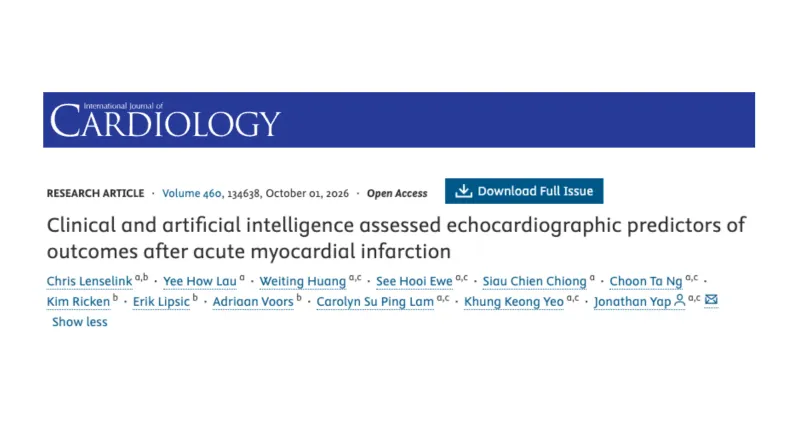
AI Echo for Post-AMI Risk Stratification: Predicting Outcomes After A Heart Attack

Published in the International Journal of Cardiology, this study of 1,001 AMI patients demonstrates that combining AI-derived echocardiographic parameters with traditional clinical risk factors significantly improves prediction of one-year mortality and major adverse cardiac events, outperforming clinical risk scores alone.
Conference abstract Research, not a cleared indication Jun 2026 European Heart Journal

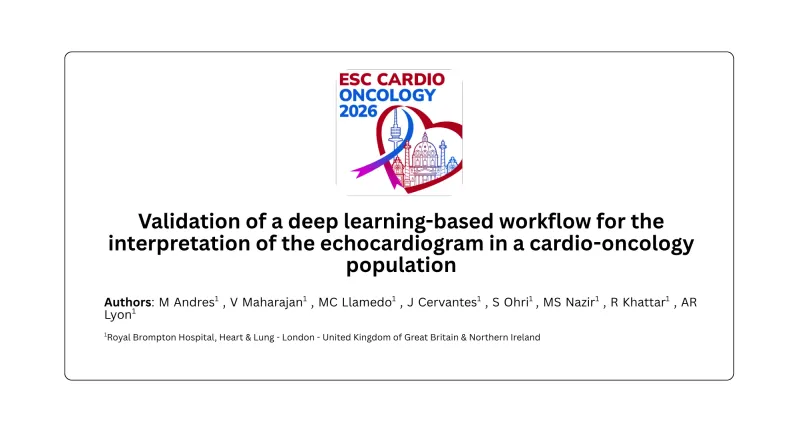
AI Echo in Cardio-Oncology: Validation in a Cancer Population

Presented at ESC Cardio-Oncology 2026, this study from Royal Brompton Hospital validates the use of AI echo in a dedicated cardio-oncology population, demonstrating strong agreement with conventional echocardiography for LVEF assessment and high accuracy for detecting clinically relevant LV dysfunction across key cancer subgroups.
Peer-reviewed paper Research, not a cleared indication Jun 2026 Circulation: Cardiovascular Imaging

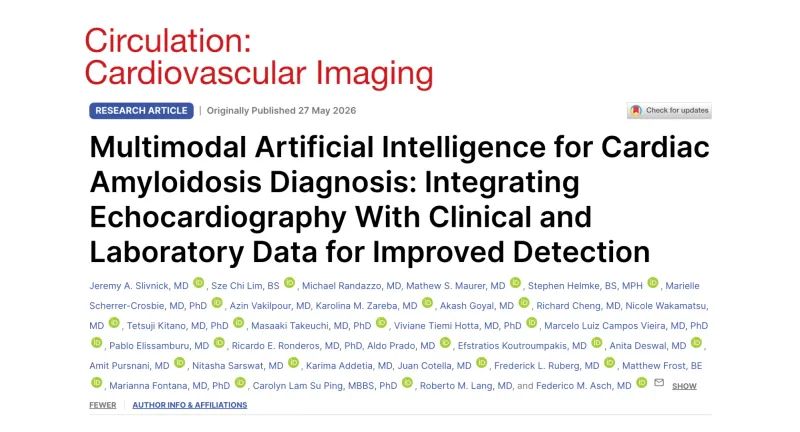
Integrating Clinical Data with AI Echocardiography for Improved Cardiac Amyloidosis Detection

Published in Circulation: Cardiovascular Imaging, this international multicentre study demonstrates that integrating clinical and laboratory data with the FDA-cleared Us2.Ca deep learning model significantly improves cardiac amyloidosis detection, achieving 93% sensitivity and 90% accuracy while eliminating indeterminate classifications entirely.
Peer-reviewed paper May 2026 ESC Heart Failure

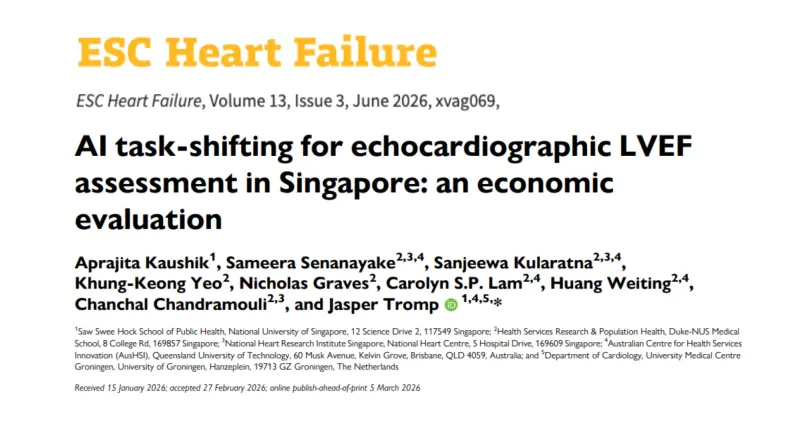
AI-Assisted Heart Failure Diagnosis: An Economic Evaluation

Published in ESC Heart Failure, this economic evaluation from Singapore demonstrates that deploying US2.ai on a novice-operated point-of-care device is cost-saving compared to conventional sonographer-led echocardiography, with a 99.9% probability of cost savings and an average reduction of S$1,185 per patient.
Conference abstract May 2026

AI Echo for LVEF Assessment in Geriatric Patients

A prospective study presented at Heart Failure Congress 2026 demonstrates that AI-assisted echocardiography using the Us2.ai software can accurately assess left ventricular ejection fraction in geriatric patients, even when performed by a geriatrician with minimal echo training.
Conference abstract May 2026 European Journal of Heart Failure

PANACEA-HF: Clinical algorithm optimizes detection of undiagnosed heart failure in primary care

PANACEA-HF study demonstrates a pragmatic clinical algorithm achieves 96.7% sensitivity and 98.8% specificity in detecting undiagnosed heart failure in primary care, outperforming unaided GP referral. Presented at Heart Failure Congress 2026.
Peer-reviewed paper May 2026 European Heart Journal

AI Echo in Community Heart Failure Screening: Methods and Implementation of the Everton BEAT Breathlessness Project

Published in the European Heart Journal, this methods paper describes the design and implementation of the BHF-funded Everton BEAT Breathlessness Project, a one-stop community diagnostic hub in Liverpool that deploys US2.ai as its AI-assisted echocardiography platform. The paper outlines how the programme brings guideline-quality cardiac assessment to underserved populations through trained non-specialist operators, with a target of screening 1,500 patients over 12 months and initiating treatment within 60 minutes of arrival.
Peer-reviewed paper May 2026 Anaesthesia

AI-Assisted Peri-Operative Echocardiography Assessment

In a prospective study across five tertiary hospitals, US2.ai demonstrated good to excellent agreement with expert clinicians across 10 echocardiographic parameters, correctly identifying 100% of pulmonary hypertension cases and all severe aortic stenosis cases. With automated reports generated in under two minutes, the findings support US2.ai as a practical tool for streamlining pre-operative cardiac assessment at scale.
Peer-reviewed paper Feb 2026 Circulation: Cardiovascular Imaging

Diagnosis of Cardiac Amyloidosis on Echocardiography Using Artificial Intelligence

This study evaluated the performance of AI-derived measurements and a deep-learning model to detect cardiac amyloidosis on echocardiography, addressing the diagnostic challenge of distinguishing it from other hypertrophic phenotypes.
Conference abstract Research, not a cleared indication Nov 2025

Uncovering Hidden Cardiac Amyloidosis with AI Echo

The AI-SCREEN-CA study evaluated the real-world performance of artificial intelligence for detecting hidden cases of cardiac amyloidosis (CA) from routine echocardiograms.
Conference abstract Research, not a cleared indication Nov 2025 Circulation

AI Echo in Paediatric Cardiology: Multicenter Validation Study

Presented at AHA Scientific Sessions 2025, this study from five paediatric centres provides the first independent validation of Us2.ai in a paediatric population, demonstrating at least moderate agreement across all echocardiographic measurements in childhood cancer survivors compared to gold-standard core laboratory readings.
Conference abstract Research, not a cleared indication Sep 2025

Detection of HCM with AI Echo

At ASE 2025, Dr. Alenzi presented a Late Breaking Science titled "AI-Automated Detection of Hypertrophic Cardiomyopathy by Echocardiography: Training and External Validation." The study showcased Us2.ai's HCM detection model, validated internally on Duke data and externally on a Japanese multicentre cohort.
Conference abstract Research, not a cleared indication Sep 2025

Multimodal AI for Cardiac Amyloidosis Diagnosis

This study combines Us2.ai's pattern recognition model with clinical and laboratory data  (AI‑ECM in this study), to enhance diagnostic accuracy for cardiac amyloidosis.
Conference abstract Sep 2025 Journal of the American Society of Echocardiography

AI Handheld Echo for Preoperative Assessment

Presented at ASE 2025, evaluating handheld echocardiography with AI software for LV diastolic dysfunction assessment.
Peer-reviewed paper Sep 2025 Catheterization and Cardiovascular Interventions

AI Echo Advances TAVI Research: The Role of COPD, Atrial Fibrillation, and Heart Failure in Symptom Improvement

A recent multicentre study published in Catheterization and Cardiovascular Interventions leveraged Us2.ai's deep learning-based echocardiography software to investigate how common comorbidities affect symptom improvement following TAVI, advancing our understanding of patient outcomes in aortic stenosis care.
Review May 2023

AI Echo White Paper

Comprehensive white paper on AI-powered echocardiography technology and clinical applications.
Peer-reviewed paper Sep 2022 Journal of the American Society of Echocardiography

AI POCUS – Handheld Echocardiography with Continuous-Wave Doppler: Implications for the Evaluation of Valvular Heart Disease

JASE publication on AI Point-of-care Ultrasound with Continuous-Wave Doppler Capability to evaluate valvular heart disease.