Presented at the Canadian Society of Echocardiography Echo Weekend 2026 | Rheaume and Chow | Abstract published in the JASE Abstract Supplement to the Canadian Society of Echocardiography (CSE) Echo Weekend 2026
Overview
Improving workflow efficiency in echocardiography laboratories is a growing clinical priority as demand for cardiac imaging continues to rise. Image acquisition, post-processing, and preliminary interpretation represent key rate-limiting steps in echocardiographic reporting, yet real-world data evaluating the impact of AI integration on laboratory workflow remain limited.
Us2.ai is a fully automated AI platform capable of processing 2D and Doppler echocardiographic images and generating structured preliminary reports. It has received Health Canada approval and demonstrated strong correlation with human-derived measurements in prior validation studies. This prospective study evaluated its real-world impact on workflow efficiency in a community outpatient echocardiography laboratory.
Study Design
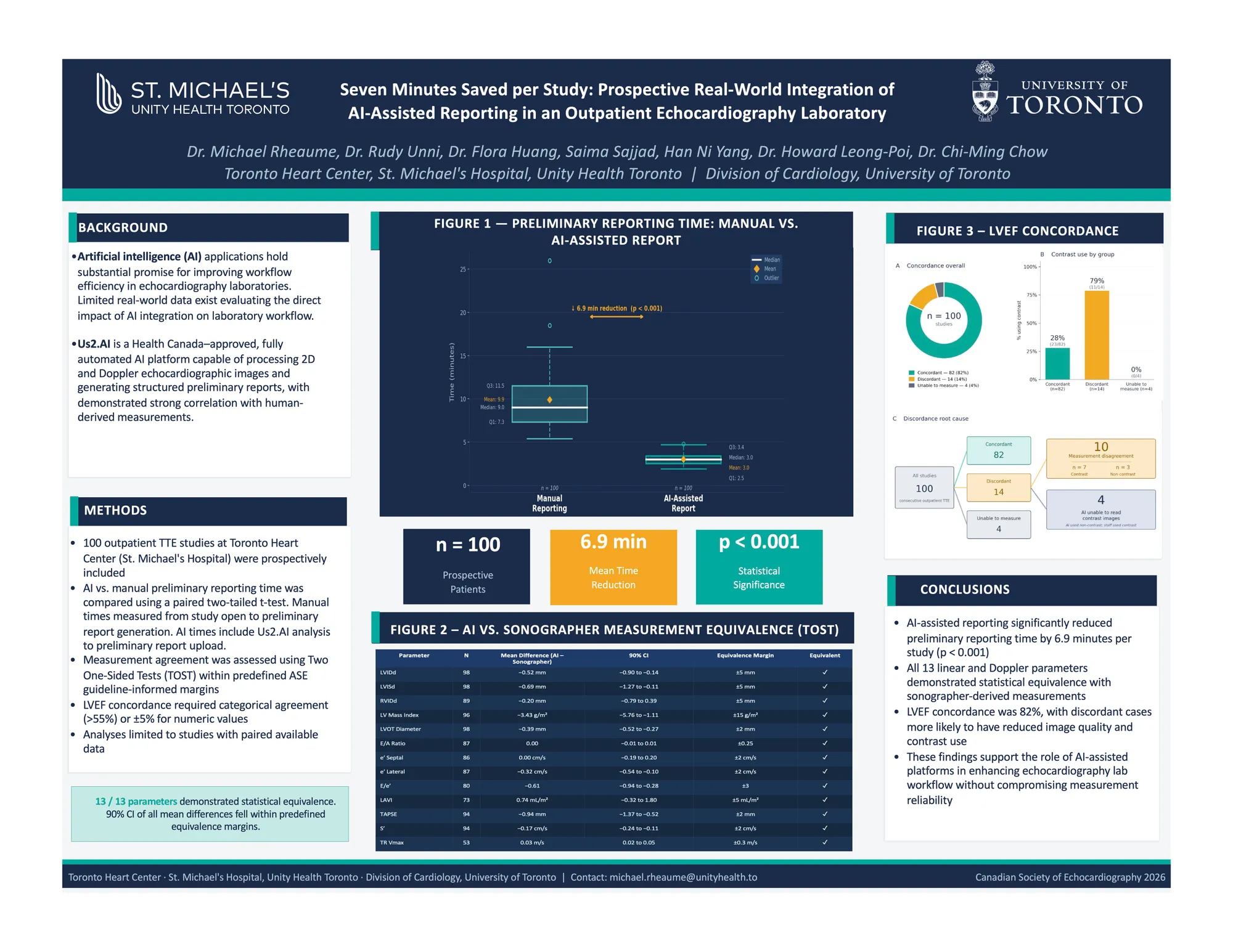
One hundred patients undergoing routine outpatient transthoracic echocardiography at Toronto Heart Center, an ambulatory cardiology clinic affiliated with St. Michael's Hospital in Toronto, Canada, were prospectively included. Preliminary reporting time using the AI-assisted pathway was compared with manual interpretation using a paired two-tailed t-test. Agreement between AI-derived and sonographer-derived measurements was assessed using two one-sided tests for equivalence within predefined guideline-informed margins reflecting clinically acceptable interobserver variability.
Key Results
Reporting Time:
- AI-assisted analysis significantly reduced preliminary reporting time compared with manual interpretation
- Mean reduction of 414 seconds per study (6.9 minutes; 95% CI 374 to 453 seconds; p<0.001)
Measurement Agreement:
- Linear and Doppler measurements demonstrated statistical equivalence with sonographer measurements
- The 90% confidence interval of mean differences fell within predefined equivalence bounds for LV and RV linear dimensions, LVOT diameter, diastolic parameters, left atrial volume index, indices of RV systolic function, and estimated RV systolic pressure
LVEF Concordance:
- LVEF concordance using predefined clinical criteria was 87% (83 of 95 studies)
- Staff reporting was categorical in 79% of studies, with concordance of preserved EF classification in 96% of cases (72 of 75)
Why This Matters
This study is notable for its real-world, prospective design in a community outpatient setting, reflecting the type of laboratory where the operational benefits of AI integration are likely to be most impactful. Unlike controlled research environments, community echocardiography laboratories often face high volumes, staffing constraints, and time pressures that make workflow efficiency a practical priority.
The finding of a nearly seven minute reduction in preliminary reporting time per study represents a meaningful operational gain at scale. Across a typical laboratory volume, this translates to significant cumulative time savings that could support increased capacity, faster turnaround, and reduced reporting burden on sonographers, without compromising the reliability of measurements used to guide clinical decisions.
Conclusion
Integration of Us2.ai into a real-world outpatient echocardiography laboratory significantly reduced preliminary reporting time while maintaining clinically acceptable agreement with sonographer-derived measurements. These findings support the potential role of AI-assisted echocardiography in enhancing workflow efficiency in routine clinical practice.
Rheaume, M., & Chow, C.-M. (2026). Seven Minutes Saved per Study: Prospective Real-World Integration of AI in Outpatient Echocardiography. Journal of the American Society of Echocardiography, 39(7), S4–S5. https://doi.org/10.1016/j.echo.2026.05.014