Article | May 8, 2024
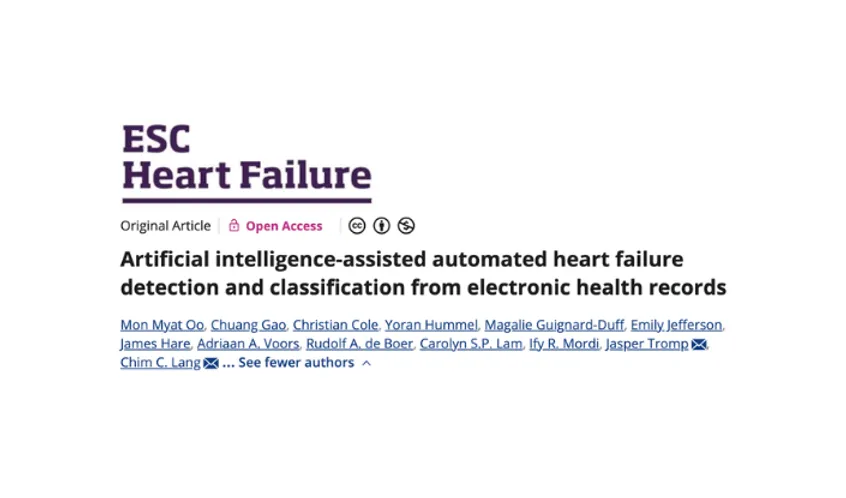
New research led by the University of Dundee, demonstrated the feasibility of AI to automatically identify and classify patients with heart failure from archived echocardiographic images with Us2.ai software.
Key Findings
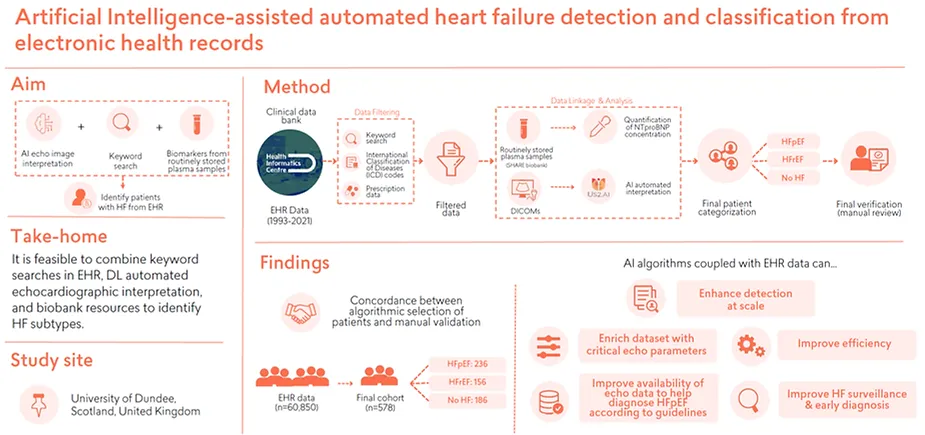
- The algorithmic workflow processed 60,850 EHR records from the Tayside and Fife region of Scotland (approximately 20% of the Scottish population), filtering down to a validated final cohort of 578 patients: 186 controls, 236 with HFpEF, and 156 with HFrEF.
- Us2.ai's deep learning analysis of archived DICOM echocardiographic images provided high parameter coverage (46-93% across parameters), accurately quantifying LV systolic and diastolic function, structural characteristics, and myocardial strain at scale, replacing the need for manual retrospective review.
- Key echocardiographic differences were clearly delineated between groups: HFrEF patients had mean LVEF of 41.6% vs. 59.6% for HFpEF and 62.7% for controls (p < 0.001), and significantly larger LV dimensions, validating the AI's ability to distinguish HF subtypes.
- Concordance between the algorithmic patient selection and manual record validation demonstrated high accuracy, supporting the approach as a reliable method for identifying and classifying HF subtypes at population scale.
- HF patients showed substantially higher risk of adverse outcomes versus controls during a median follow-up of 1,089 days: 37% of HFpEF and 58% of HFrEF patients experienced HF hospitalisation or all-cause death, compared with 5% of controls, confirming the clinical validity of the AI-identified cohorts.
View the full manuscript here →
Oo, M. M., Gao, C., Cole, C., Hummel, Y., Guignard‐Duff, M., Jefferson, E., Hare, J., Voors, A. A., De Boer, R. A., Lam, C. S., Mordi, I. R., Tromp, J., & Lang, C. C. (2024). Artificial intelligence‐assisted automated heart failure detection and classification from electronic health records. ESC Heart Failure, 11(5), 2769-2777. https://doi.org/10.1002/ehf2.14828