Overview
Heart failure affects an estimated 64 million people worldwide, yet more than 40% of patients report symptoms for up to five years before receiving a diagnosis. In resource-constrained settings, access to echocardiography remains limited by equipment costs, workforce shortages, and the need for specialist interpretation. Individuals with type 2 diabetes face particularly elevated cardiovascular risk, with heart failure incidence approximately 2.5 times higher than in non-diabetic populations, yet up to 50% remain undiagnosed in primary care.
The Heart2Miss initiative was designed to address this gap directly, deploying Us2.ai-powered AI point-of-care ultrasound within a decentralized community-based hub-intermediary-spoke model to enable early heart failure detection in high-risk diabetes patients attending primary care clinics in Sarawak, Malaysia.
Study Design
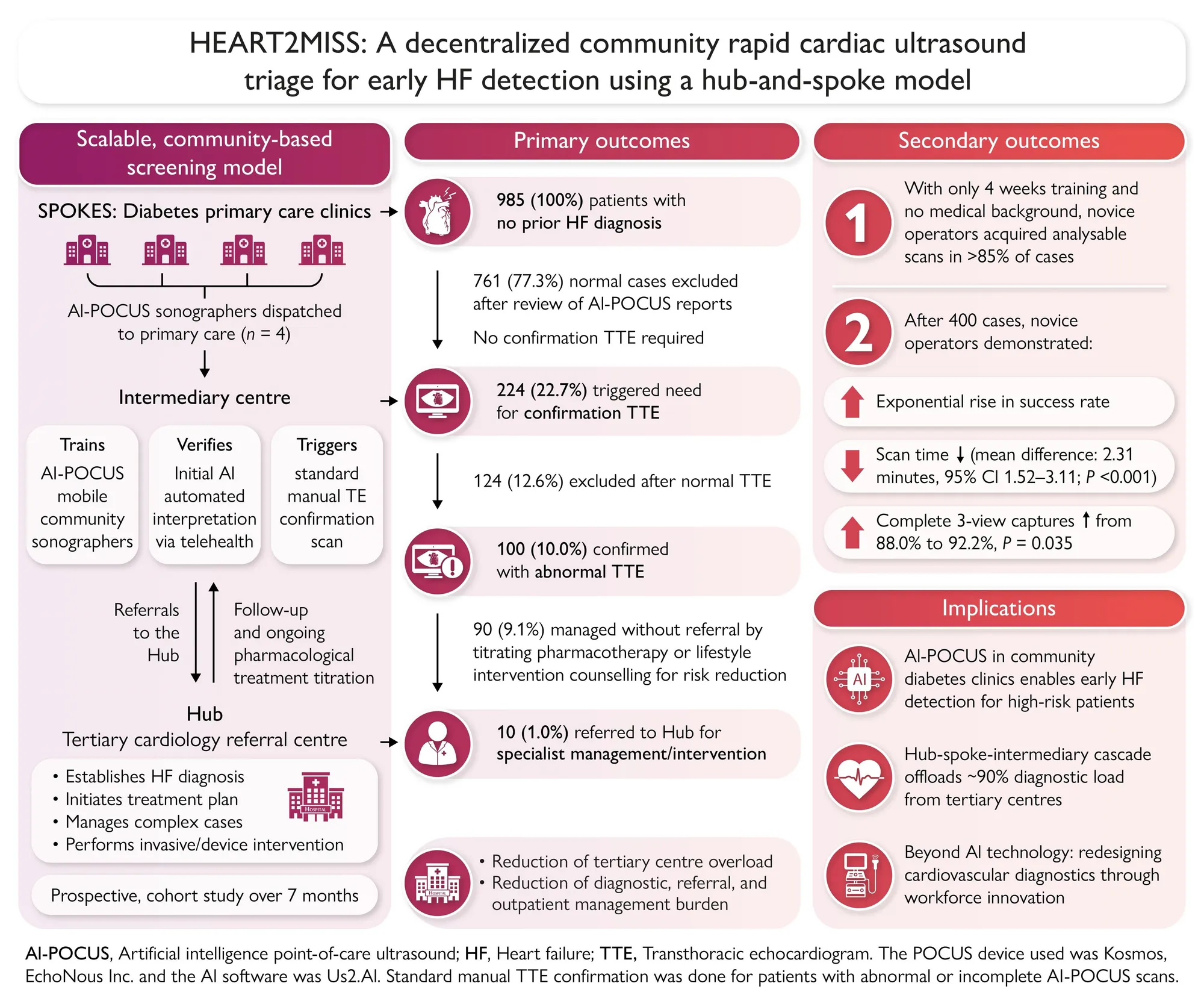
This prospective study screened 1,000 adults with type 2 diabetes and no prior heart failure diagnosis across six primary care diabetes clinics over seven months. Novice biomedical and bioscience graduates underwent a structured four-week training programme to perform focused three-view handheld AI-POCUS, using the Us2.ai FDA-cleared automated workflow for image analysis and cardiac parameter measurement.
The model operated across three tiers. Community primary care clinics served as spokes, where trained novice sonographers performed rapid AI-POCUS triage. Sarawak General Hospital Clinical Research Centre served as the intermediary, remotely verifying AI analyses via telehealth, performing confirmatory transthoracic echocardiography where indicated, and managing patients locally where possible. Sarawak Heart Centre served as the tertiary hub, receiving only those patients requiring specialist assessment or intervention.
The primary outcome was detection of previously undiagnosed heart failure. Secondary outcomes included reduction in tertiary diagnostic burden and novice sonographer performance.
Key Results
Heart Failure Detection:
- 11.1% of screened patients (n=109) were identified with Stage B pre-heart failure
- 1.0% (n=10) had previously undiagnosed Stage C symptomatic heart failure
- All Stage C cases represented new diagnoses with no prior history of heart failure
Reduction in Tertiary Burden:
- 77.3% of patients were ruled out at the spoke level after normal AI-POCUS findings, without requiring confirmatory echocardiography
- A further 12.6% were excluded after confirmatory testing at the intermediary level
- Only 1.0% of the screened population required escalation to the tertiary cardiology hub
- The hub-intermediary-spoke pathway reduced tertiary diagnostic burden by 89.9%
Novice Sonographer Performance:
- After four weeks of training, novice sonographers achieved over 90% analysable scan rates for key left ventricular parameters and over 85% for left atrial volume
- After 400 cumulative cases, mean scan time fell from 11.0 minutes to 8.3 minutes (p<0.001)
- Complete three-view capture improved from 88.0% to 92.2% (p=0.035)
Why This Matters
This study demonstrates that Us2.ai can serve as the analytical backbone of a scalable, community-based heart failure screening programme, enabling non-specialist operators to deliver clinically meaningful cardiac triage after minimal training. The model is particularly relevant for low- and middle-income settings where echocardiography access is constrained and specialist workforces are stretched.
The hub-intermediary-spoke architecture is a practical and replicable framework for embedding AI-assisted echocardiography into primary care pathways. By resolving the vast majority of cases within the spoke-intermediary loop, the model preserves tertiary capacity for patients with the greatest clinical complexity, while ensuring that high-risk patients in the community are identified and managed earlier in their disease course.
The study also highlights an often overlooked dimension of AI-assisted echocardiography: its potential to address workforce challenges by enabling biomedical and bioscience graduates to contribute meaningfully to cardiovascular screening, closing diagnostic gaps while creating structured clinical roles for an underemployed graduate workforce.
Conclusion
The Heart2Miss initiative demonstrates that a decentralized hub-intermediary-spoke model combining Us2.ai-powered AI-POCUS, telehealth verification, and a task-shifted novice workforce can effectively detect previously undiagnosed heart failure while substantially reducing specialist workload. The findings support broader adoption of this model as a pragmatic pathway for community-based heart failure prevention in resource-constrained settings.
Read the news coverage of the abstract presentation at Heart Failure 2025 here →
Foo, D. H.-P., Yeo, J. J.-P., Yen, Y. Y. Y., Bumphray, S. T., Jong, R. H.-C., Sumbu, L. L., Jana, C. L., Jennett, M., Ishak, M., Jerampang, P., Mustapha, M., Ahip, S. S., Hamden, L., Igo, M., Sulaiman, M. N. A., Chunggat, J., Chong, F. G., Enggong, D. B., Chung, Y., … Fong, A. Y.-Y. (2026, August 10). Decentralised Community-Based Hub-Intermediary-Spoke Model for Rapid Cardiac Ultrasound Triage for Early Heart Failure Detection: Findings From the Heart2Miss Initiative. European Heart Journal - Digital Health. https://doi.org/10.1093/ehjdh/ztag115