Article | May 16, 2025
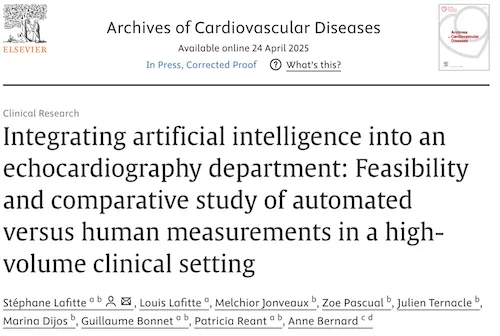
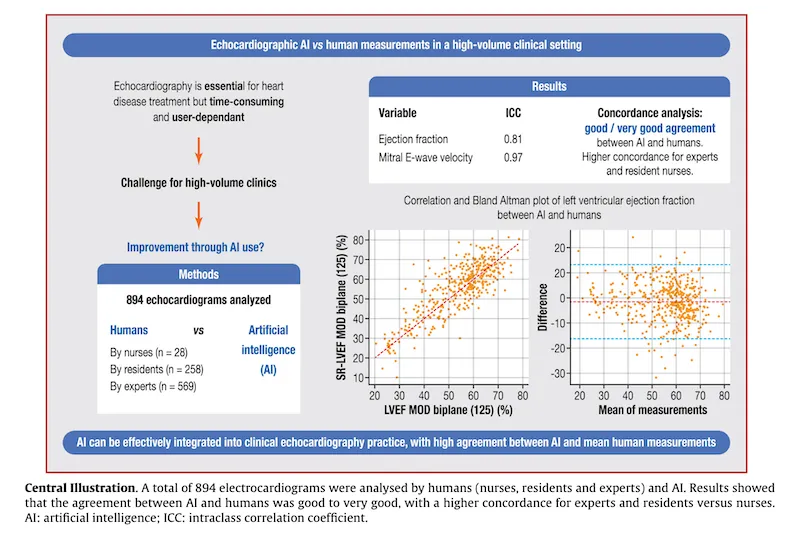
This study from Bordeaux University Hospital evaluated the real-world use of AI in echocardiography, analyzing nearly 900 echo scans across varying operator experience levels. Results showed strong agreement between AI-generated and human measurements—particularly for ejection fraction and Doppler-based parameters—highlighting AI's potential to streamline workflow and reduce variability. The Us2.ai software was integrated into the hospital system within six weeks, demonstrating its feasibility in busy clinical settings. This research highlights the promise of AI to enhance efficiency in cardiac imaging without compromising diagnostic quality.
Key Findings
- Us2.ai was integrated into Bordeaux University Hospital's IT infrastructure within 6 weeks, across a department performing over 21,000 echocardiograms annually, demonstrating real-world deployment feasibility at scale.
- Agreement between AI and human measurements was good to very good across nearly 900 scans: ICC 0.81 for ejection fraction and ICC 0.97 for Doppler-based mitral E wave velocity, two of the most clinically critical parameters.
- Bland-Altman analysis showed a global mean difference of -4% with a standard deviation of 15%, confirming acceptable systematic bias across the full parameter set.
- Agreement was highest among cardiologists and residents (mean ICC 0.78-0.79) versus nurses (mean ICC 0.72), indicating performance scales with operator experience but remains acceptable across all groups.
Access the full publication here →
Integrating AI into an Echocardiography Department
Lafitte, S., Lafitte, L., Jonveaux, M., Pascual, Z., Ternacle, J., Dijos, M., Bonnet, G., Reant, P., & Bernard, A. (2025). Integrating artificial intelligence into an echocardiography department: Feasibility and comparative study of automated versus human measurements in a high-volume clinical setting. Archives of Cardiovascular Diseases. https://doi.org/10.1016/j.acvd.2025.04.051