Detect Heart Failure Across Every Phenotype
Echocardiography defines the heart failure phenotype, HFrEF, HFmrEF, or HFpEF. Us2.ai detects and measures every guideline-recommended parameter (LVEF, GLS, diastolic function, and more) with the accuracy and reproducibility diagnosis depends on, automatically on every scan.
The World's Fastest-Growing Cardiovascular Epidemic
Heart failure affects 1–2% of adults in developed countries and over 10% of those aged 70+. Hospital admissions for HF are projected to increase 50% in the next 25 years.
Heart failure is a global pandemic. With aging populations and increasing prevalence of risk factors, the burden is growing faster than the workforce can keep up.
One in five heart failure patients die within a year of diagnosis. Five-year mortality reaches 53–67%, worse than many cancers.
After an acute heart failure hospitalization, over 45% of patients die or are readmitted within 12 months. Early, accurate diagnosis is the first step to changing this.
Three Phenotypes, One Diagnostic Tool
International guidelines classify heart failure by LVEF. Echocardiography defines the phenotype and directly determines the treatment pathway.
Accurate Detection Across Every Heart Failure Phenotype
Heart failure detection hinges on echocardiography. Us2.ai measures every parameter in the diagnostic pathway with the accuracy and reproducibility that distinguishes HFrEF, HFmrEF, and HFpEF.
LVEF Classification
Accurate, reproducible LVEF measurement is the single most important echo parameter in heart failure. It defines the phenotype and determines the treatment pathway. Us2.ai reduces inter-observer variability.
Diastolic Function Assessment
E/e' ratio, LA volume index, and TR velocity are critical for diagnosing HFpEF. Us2.ai measures all diastolic parameters on every study, essential for the most diagnostically challenging HF phenotype.
Global Longitudinal Strain
GLS detects subclinical dysfunction before LVEF drops. International guidelines note GLS <16% as a marker for HFpEF, and a ≥12% relative GLS reduction is superior to LVEF for detecting cardiotoxicity.
Right Heart & Structural Assessment
TAPSE, RV function, LA volume index, LV mass index, and relative wall thickness. Us2.ai delivers the full structural assessment that supports HFmrEF and HFpEF diagnosis.
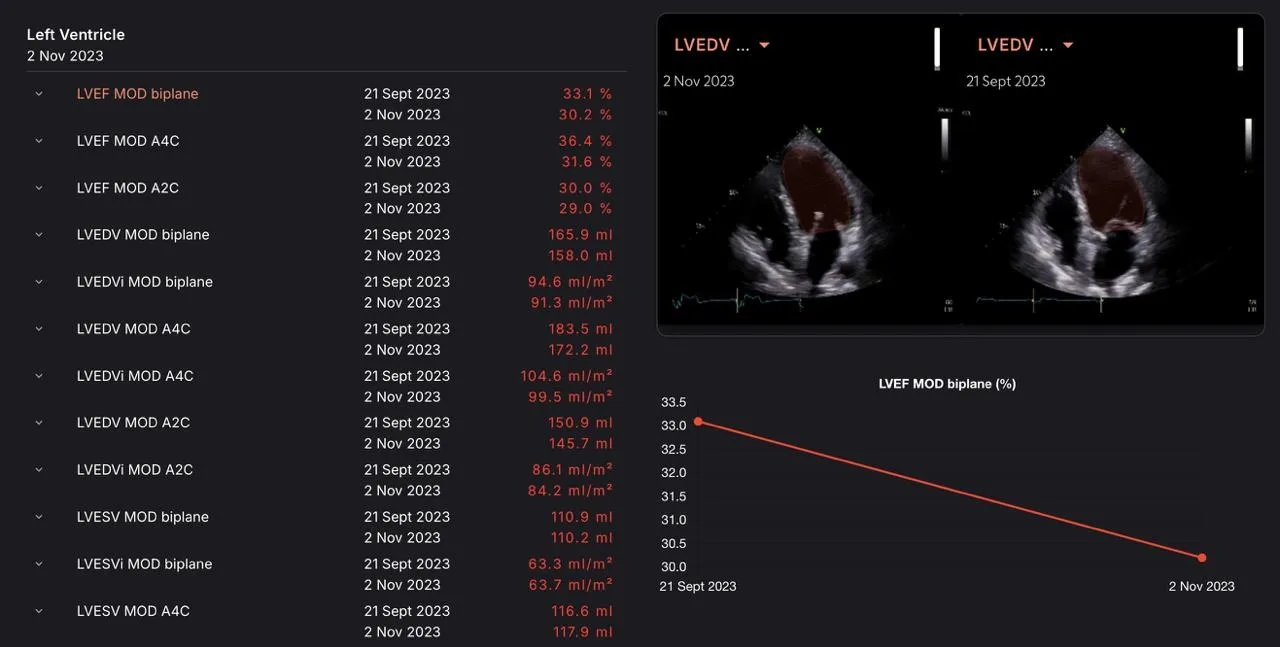
International guidelines recommend a follow-up 3–6 months after therapy optimization and at any clinical deterioration. Us2.ai’s automated, standardized measurements enable reliable serial comparison, detecting changes that matter and tracking treatment response over time.
Validated by Leading Heart Failure Clinicians
Us2.ai was validated against expert sonographers across four independent international cohorts, with results published in The Lancet Digital Health. Two of the field's most prominent heart failure investigators discuss what the evidence shows.
I was so skeptical. I don't think it's going to work. But I have come around to realizing that not only does it work. We absolutely need this.
If you take multiple cohorts and test against expert human readers, the message again and again is: it's as good if not better than humans. Trust the numbers.
Tromp J, Seekings PJ, Hung C-L, et al. Automated interpretation of systolic and diastolic function on the echocardiogram: a multicohort study
Lancet Digit Health 2022;4(1):e46–e54
A deep-learning workflow validated against expert human readers across four independent international cohorts. The AI detected reduced and preserved ejection fraction heart failure as accurately as expert sonographers, with less measurement variability, supporting reproducible, guideline-concordant assessment at scale.
Read the validation studyAI-Assisted Detection of Heart Failure from Electronic Health Records
Published with the University of Dundee, this study demonstrates how AI echocardiography can identify missed heart failure patients from electronic health records.
Oo et al. Artificial Intelligence-Assisted Automated Heart Failure Detection and Classification from Electronic Health Records
ESC Heart Fail 2024;11:2769–2777
A collaboration with the University of Dundee demonstrating that AI-assisted echocardiography analysis can systematically identify heart failure patients who were missed through conventional clinical pathways, enabling earlier diagnosis and treatment initiation.
Why Automated Echo Matters for Heart Failure
International guidelines place echocardiography at the center of HF diagnosis. Automation addresses the key barriers to guideline-concordant care.
Reducing LVEF Variability
International guidelines acknowledge that LVEF measurement is "subject to substantial variability." Automated analysis delivers consistent, reproducible EF, critical when treatment decisions hinge on whether EF is 39% or 41%.
Scaling with Demand
HF admissions are projected to rise 50% in 25 years. The guidelines call for more screening in asymptomatic subjects. Automated echo analysis is the only way to meet growing demand without proportionally growing the specialist workforce.
HFpEF: The Diagnostic Challenge
HFpEF remains the most difficult HF phenotype to diagnose, requiring integration of multiple echo parameters. The guidelines note "ongoing diagnostic uncertainty." Automated multi-parameter reporting helps clinicians apply the criteria consistently.
Frequently Asked Questions
Common questions about heart failure and AI echocardiography.
How common is heart failure?
What role does echocardiography play in heart failure diagnosis?
How does AI echocardiography help with heart failure?
What are the different types of heart failure?
Can AI echocardiography identify the underlying cause of heart failure?
What clinical evidence supports AI heart failure detection?
Are Us2.ai heart failure measurements guideline-compliant and explainable?
Echocardiography defines the HF phenotype. Accuracy makes detection reliable.
Complete Heart Failure Detection, Every Phenotype
Us2.ai measures LVEF, GLS, diastolic function, and the full structural assessment with the accuracy and reproducibility that distinguishes HFrEF, HFmrEF, and HFpEF, automatically on every scan.