Overview
Heart failure with preserved ejection fraction (HFpEF) remains difficult to diagnose, and only natriuretic peptides and troponins are currently recommended in international guidelines. Understanding how cardiac structure and function relate to circulating biomarkers across the ejection fraction spectrum could improve diagnosis, surveillance and patient selection for clinical trials.
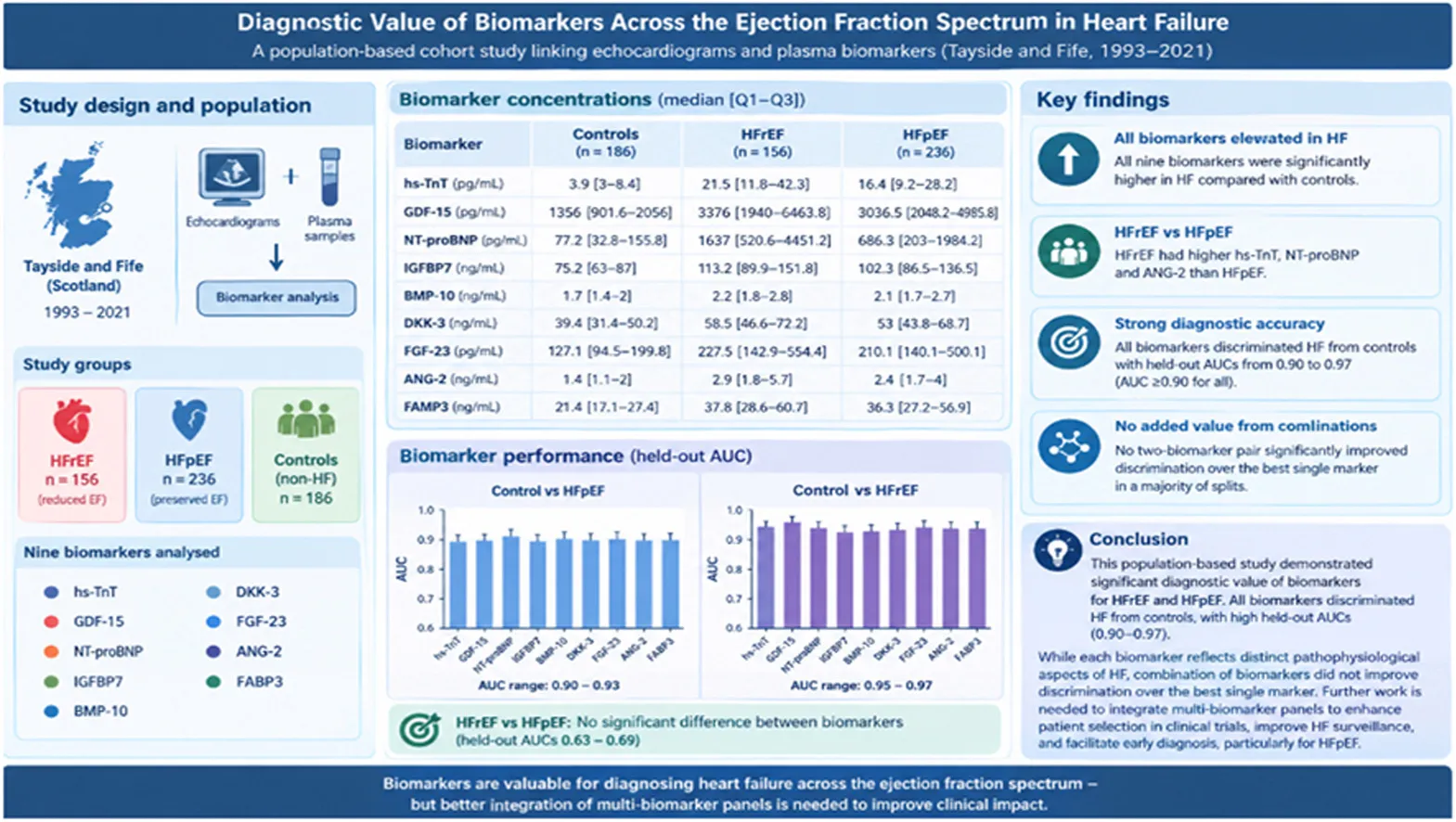
This study linked automated echocardiographic analysis with plasma biomarker data in a population-based cohort, asking two questions: how do nine biomarkers perform in diagnosing heart failure across the ejection fraction spectrum, and does combining them improve diagnosis?
Study Design
Researchers from the University of Dundee and collaborating centres used linked electronic health record data from the Tayside and Fife regions of Scotland (1993 to 2021). Echocardiograms were matched with biobank plasma samples. The cohort included 156 patients with HFrEF, 236 with HFpEF, and 186 controls without heart failure.
All echocardiograms were analysed using Us2.ai's automated deep learning algorithm, which generated measurements across LV dimensions and mass, systolic and diastolic function, global longitudinal strain, left atrial volume, right ventricular function and right atrial size. This allowed each patient to be characterised across more than 20 echocardiographic parameters without manual measurement, a scale of phenotyping that would be impractical to perform manually across decades of routine clinical studies.
Nine biomarkers were measured: hs-TnT, NT-proBNP, GDF-15, IGFBP7, BMP-10, DKK-3, FGF-23, ANG-2 and FABP3. Discrimination was assessed using held-out AUC across 200 repeated 70/30 split-sample validations, adjusted for age, sex, eGFR, diabetes, atrial fibrillation, coronary artery disease and COPD.
Key Results
AI Echo Phenotyping (Us2.ai):
- Automated analysis characterised cardiac structure and function across HFrEF, HFpEF and control groups, with measurement coverage ranging from 46% to 93% across parameters
- LVEF was lowest in HFrEF (41.6%), compared with 59.6% in HFpEF and 62.7% in controls (p<0.001)
- Global longitudinal strain was most impaired in HFrEF (-12.1%), followed by HFpEF (-18.4%) and controls (-21.2%) (p<0.001)
- Diastolic and filling pressure markers rose across the spectrum, with mean E/e' of 7.7 in controls, 10.3 in HFpEF and 12.6 in HFrEF (p<0.001)
- Left atrial end-systolic volume was higher in HFpEF (52.4 mL) and HFrEF (59.3 mL) than in controls (35.9 mL) (p<0.001)
- LV mass, TAPSE and TR Vmax also differed significantly across groups, with both heart failure groups showing greater LV mass, higher pulmonary artery systolic pressure, more impaired LV strain and RV dysfunction than controls
Biomarker Performance:
- All nine biomarkers were significantly elevated in heart failure compared with controls
- All discriminated heart failure from controls, with held-out AUCs from 0.90 to 0.97
- NT-proBNP performed best for HFrEF versus controls (AUC 0.97) and well for HFpEF versus controls (AUC 0.92)
- hs-TnT, NT-proBNP and ANG-2 were higher in HFrEF than HFpEF
Biomarker Combinations:
- All 36 two-biomarker pairs were tested
- No pair significantly improved discrimination over its best single biomarker in a majority of splits
Why This Matters
Biomarker and imaging data are complementary in heart failure, but combining them at scale has historically been limited by the effort of measuring echocardiograms manually. This study shows how automated echo analysis makes it feasible to link comprehensive cardiac phenotyping with biobank and electronic health record data in a population-based cohort.
The echocardiographic profiles captured by Us2.ai showed the expected progression across the ejection fraction spectrum, from reduced LVEF and impaired strain in HFrEF to raised filling pressures and left atrial enlargement in HFpEF. This gives researchers a structured, reproducible imaging phenotype to set alongside biomarker data, which supports future work on patient selection for clinical trials, heart failure surveillance and earlier diagnosis, particularly for HFpEF.
The authors note that biomarkers other than NT-proBNP, hs-TnT and GDF-15 are research-use assays, and that these results do not demonstrate immediate clinical applicability.
Conclusion
This population-based study demonstrated significant diagnostic value of multiple biomarkers for HFrEF and HFpEF, with all biomarkers discriminating heart failure from controls. Combining biomarkers did not improve discrimination over the best single biomarker. Automated echocardiographic analysis with Us2.ai enabled comprehensive cardiac phenotyping across the cohort, supporting further work on integrated imaging and biomarker approaches to heart failure diagnosis.
Mon Myat, O., Chuang, G., Cole, C., Hummel, Y., Guignard-Duff, M., Voors, A. A., de Boer, R. A., Lam, C. S. P., Tromp, J., & Lang, C. C. (2026). Multi-panel biomarkers for diagnosis of heart failure across the ejection fraction spectrum: A population-based study. International Journal of Cardiology Cardiovascular Risk and Prevention, 200721. https://doi.org/10.1016/j.ijcrp.2026.200721