Overview
Echocardiography is the cornerstone of risk stratification, diagnosis, and monitoring of cancer therapy-related cardiac dysfunction (CTRCD), a serious and increasingly recognised complication of modern oncological treatments. As cancer survival rates improve and cardiotoxic therapies become more widely used, the demand for accurate, efficient, and reproducible cardiac monitoring in oncology patients is growing rapidly.
While AI-guided echocardiography has demonstrated high accuracy and reliability across diverse cardiac populations, it had not previously been validated in a dedicated cohort of patients with cancer, a population that presents unique clinical challenges including pericardial effusion, prior radiotherapy, and a higher prevalence of obesity. This study addresses that gap directly, providing validation of Us2.ai in a real-world cardio-oncology setting.
Study Design
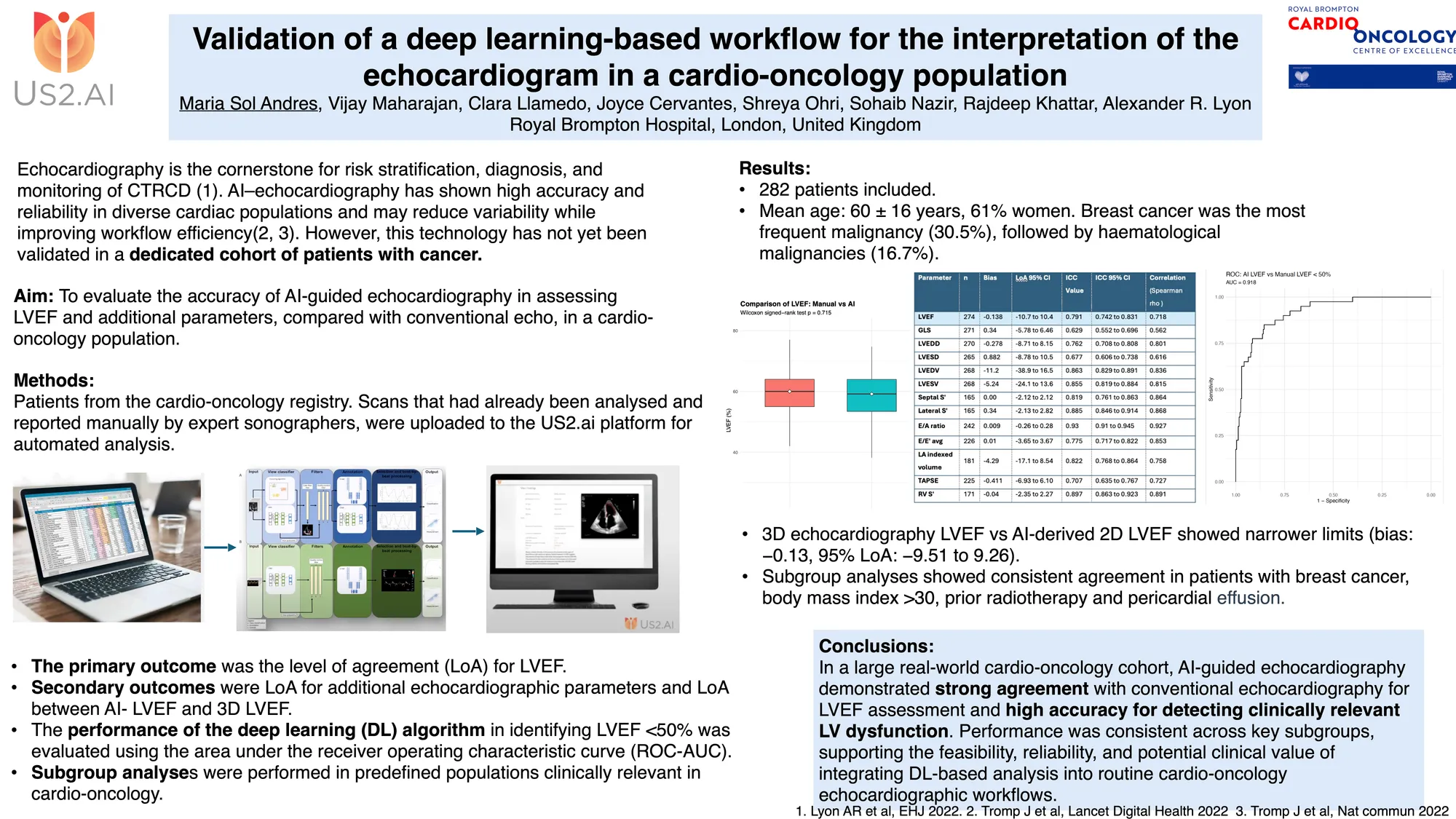
This retrospective study included 282 patients identified from the cardio-oncology registry at Royal Brompton Hospital, London. Studies that had already been analysed and reported manually by expert sonographers were uploaded to the Us2.ai platform for automated analysis. The mean age of patients was 60 years, 61% were women, and breast cancer was the most frequent malignancy at 30.5%, followed by haematological malignancies at 16.7% and gastrointestinal tumours at 10.6%.
The primary outcome was the level of agreement between AI-guided and standard echocardiography for LVEF. Secondary outcomes included agreement for additional echocardiographic parameters and agreement between AI-derived 2D LVEF and 3D echocardiography LVEF. The performance of the deep learning algorithm in identifying LVEF below 50% was evaluated using ROC-AUC. Subgroup analyses were performed in populations of particular clinical relevance in cardio-oncology.
Key Results
LVEF Agreement:
- AI-derived and manually measured LVEF showed good agreement, with a bias of -0.138 and 95% limits of agreement of -10.7 to 10.4
- ICC of 0.791 (95% CI: 0.742 to 0.831) and Spearman correlation of 0.718
- Manual median 2D LVEF was 60% compared to AI-derived LVEF of 59.2%, demonstrating close alignment in practice
3D Echocardiography Comparison:
- Comparison between 3D echocardiography LVEF and AI-derived 2D LVEF showed similar agreement with narrower limits of agreement (bias: -0.13, 95% LoA: -9.51 to 9.26), suggesting AI-derived 2D measurements compare favourably even against 3D assessment
Detection of LV Dysfunction:
- The deep learning algorithm demonstrated high accuracy for identifying clinically relevant LV dysfunction, with a ROC-AUC of 0.918 (95% CI: 0.875 to 0.961) for detection of LVEF below 50%
Subgroup Analyses:
- Consistent agreement was confirmed across patients with breast cancer, BMI above 30, prior radiotherapy, and pericardial effusion, four populations that represent common and clinically challenging presentations in cardio-oncology practice
Why This Matters
Patients undergoing cancer treatment require regular cardiac monitoring to detect CTRCD early, often across multiple time points and frequently in busy oncology settings where access to expert sonographers may be limited. Variability in manual echocardiographic assessment adds further complexity to serial monitoring, where consistent measurement is critical to detecting meaningful changes in cardiac function.
This study demonstrates that Us2.ai can deliver accurate, reproducible LVEF assessment in cancer patients, including those with clinical characteristics that might be expected to challenge automated analysis. The consistency of performance across key subgroups is particularly reassuring for clinicians considering integration of AI-assisted echocardiography into routine cardio-oncology workflows.
Conclusion
The findings support the feasibility, reliability, and potential clinical value of integrating Us2.ai into routine cardio-oncology echocardiographic practice, with implications for improving workflow efficiency and reducing inter-observer variability in cardiac monitoring for patients with cancer.
Andres, M., Maharajan, V., Llamedo, M. C., Cervantes, J., Ohri, S., Nazir, M. S., Khattar, R., & Lyon, A. R. (2026). Validation of a deep learning-based workflow for the interpretation of the echocardiogram in a cardiooncology population. European Heart Journal Supplements, 28(Supplement_8). https://academic.oup.com/eurheartjsupp/article/28/Supplement_8/suag097.220/8750091