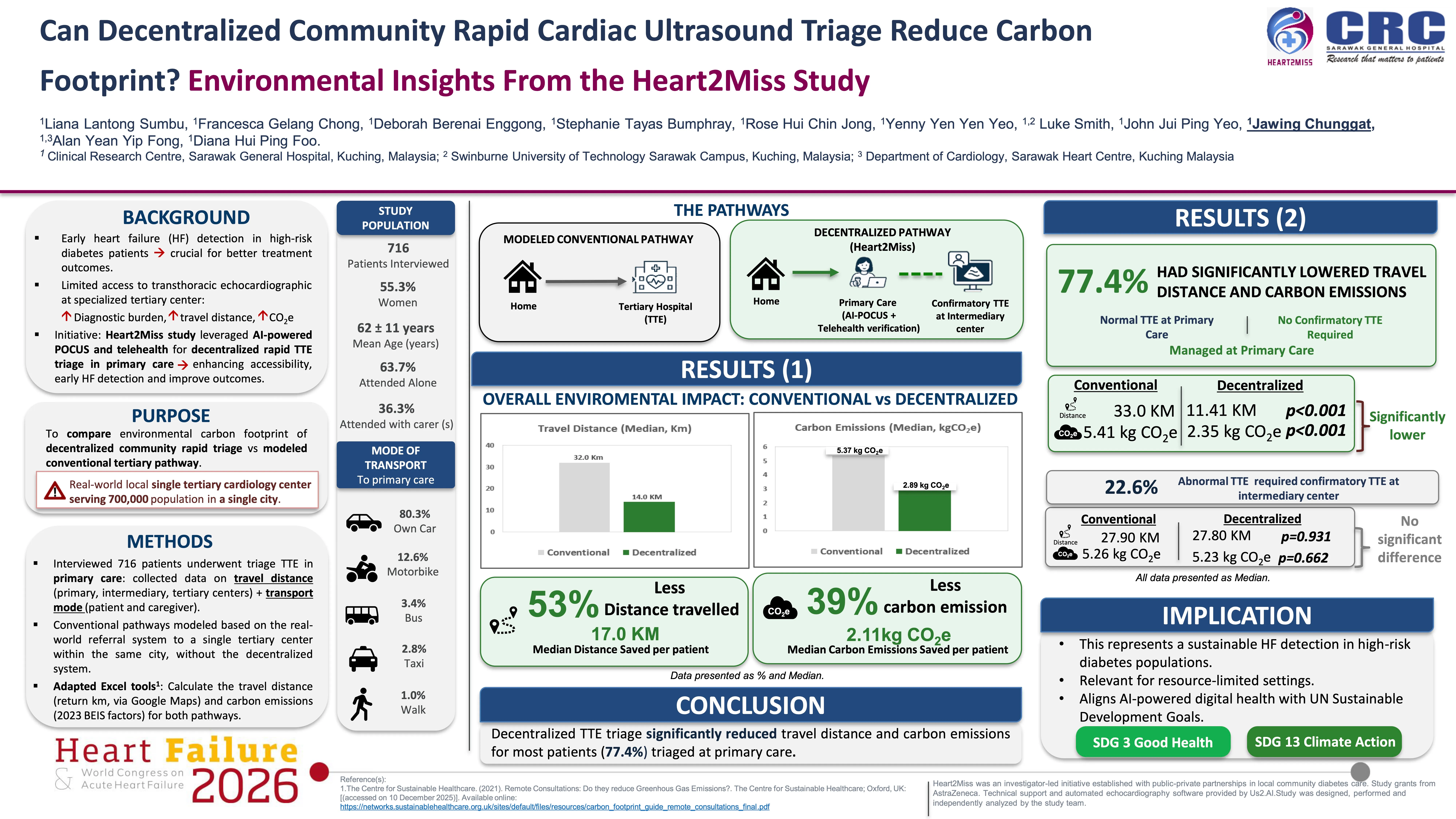
Early heart failure detection in high-risk diabetes patients typically requires echocardiography at specialist tertiary centres, adding diagnostic burden, long patient journeys, and an often-overlooked environmental cost.
The Heart2Miss study deployed AI-powered handheld POCUS with remote telehealth verification at primary care level, bringing cardiac triage closer to where patients already go. This environmental sub-study measured whether decentralising that triage pathway meaningfully reduces carbon emissions compared to a conventional tertiary referral model.
Across 716 patients interviewed, the decentralised approach saved a median 17.0 km of travel and 2.11 kg CO₂e per patient: a 53% reduction in distance and 39% reduction in carbon emissions. The benefit was most pronounced for the 77.4% of patients whose triage TTE was normal and required no further testing.
Key findings
- 53% less distance travelled per patient (median 14.0 km vs. 32.0 km)
- 39% fewer carbon emissions (median 2.89 vs. 5.37 kg CO₂e)
- 77.4% of patients managed entirely at primary care level with no onward referral needed
- Savings were statistically significant for normal-triage patients (p < 0.001); no significant difference for those requiring confirmatory TTE
Implications
This work suggests that AI-powered decentralised cardiac diagnostics can be both clinically effective and environmentally responsible, a model relevant to resource-limited settings globally, and aligned with UN Sustainable Development Goals SDG 3 (Good Health) and SDG 13 (Climate Action).
Heart2Miss Study Results
Learn more about the Heart2Miss Study and explore the presented findings. View results →
Sumbu, L. L., Chong, F. G., Enggong, D. B., Bumphray, S. T., Jong, R. H. C., Yeo, Y. Y. Y., Smith, L., Yeo, J. J. P., Chunggat, J., Fong, A. Y. Y., & Foo, D. H. P. (2026). Can decentralized community rapid cardiac ultrasound triage reduce carbon footprint? Environmental insights from the Heart2Miss study. European Journal of Heart Failure, 28(Supplement_2). https://doi.org/10.1093/ejhf/xuag193.1412