Overview
Accurate assessment of left ventricular ejection fraction is the cornerstone of heart failure diagnosis, yet access to trained cardiac sonographers remains a significant bottleneck in many healthcare systems. Long waiting times delay diagnosis and the initiation of treatment, with real consequences for patient outcomes and healthcare costs. This economic evaluation from Singapore asks a practical question: can AI-assisted point-of-care echocardiography, operated by a novice, deliver the same diagnostic outcomes at lower cost than conventional sonographer-led assessment?
Study Design
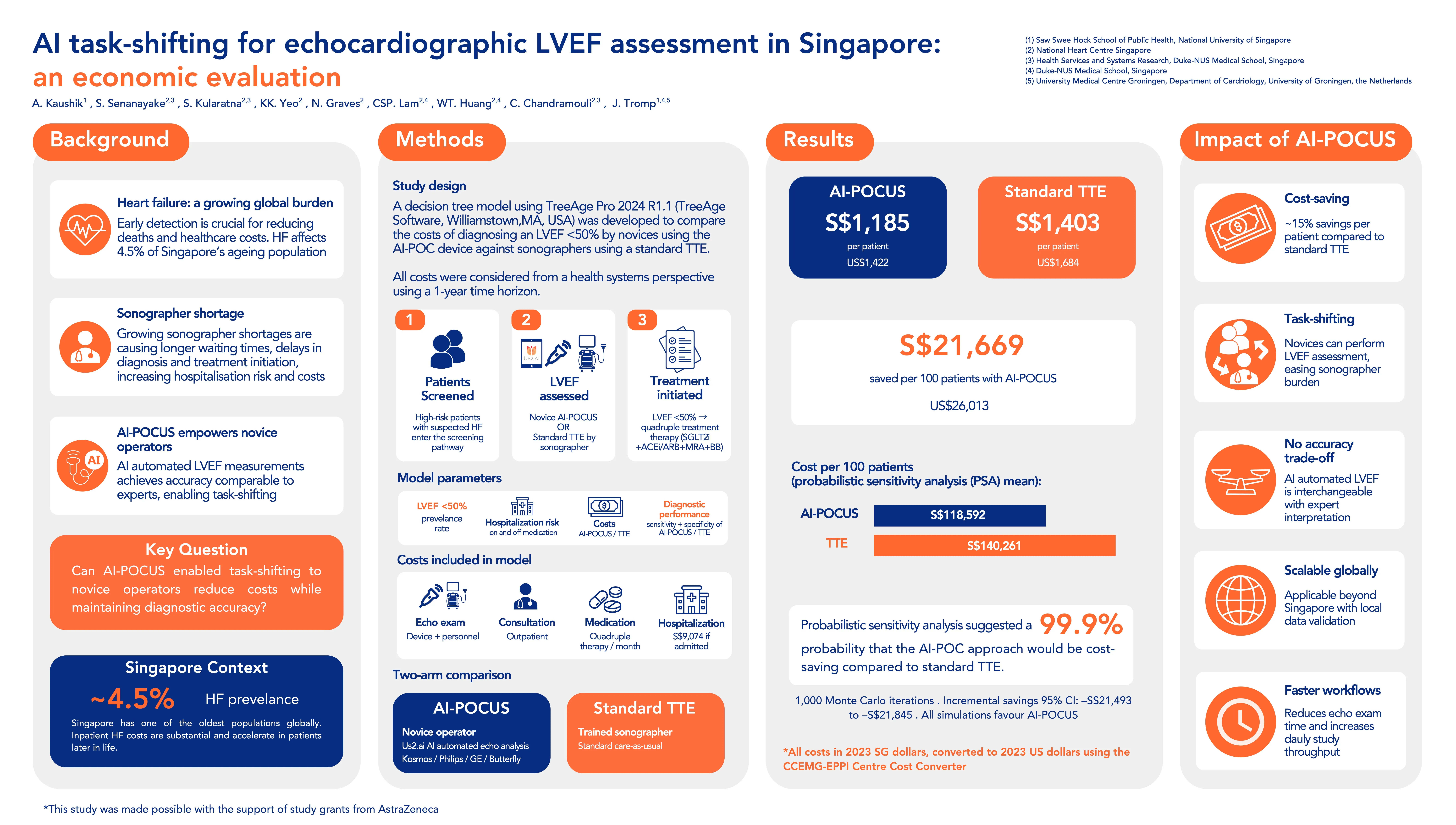
Researchers from the National University of Singapore and Duke-NUS Medical School conducted a cost-minimisation analysis using a decision tree model, comparing two diagnostic pathways for patients with suspected heart failure. The first pathway involved novice-operated AI-assisted point-of-care ultrasound using US2.ai, the validated deep learning workflow for automated echocardiographic interpretation. The second was standard transthoracic echocardiography performed and interpreted by a trained cardiac sonographer.
The analysis was conducted from a health systems perspective over a one-year time horizon, incorporating the costs of equipment, personnel, medication, and hospitalisation. A probabilistic sensitivity analysis with 1,000 Monte Carlo iterations tested the robustness of findings across the full range of model assumptions.
Key Results
- The AI-assisted pathway delivered substantial cost savings. The average cost per patient was S$1,185 (US$1,422) for the novice-led AI pathway, compared to S$1,403 (US$1,684) for conventional sonographer-led echocardiography. Across a simulated cohort of 100 patients at a single tertiary centre in Singapore, this translated to total savings of S$21,669 (US$26,013).
- Probabilistic sensitivity analysis confirmed the robustness of these findings, with a 99.9% probability that the AI-assisted pathway would be cost-saving compared to standard care.
- Importantly, these cost savings were achieved without compromising diagnostic accuracy. Drawing on prior validation data, the analysis established that the proportion of patients correctly diagnosed and started on heart failure treatment did not differ statistically between the two pathways.
*All costs are in 2023 SG dollars, converted to 2023 US dollars, using the 'CCEMG-EPPI Centre Cost Converter' web-based tool.
Why This Matters
Sonographer shortages are a well-documented challenge across healthcare systems globally, contributing to diagnostic delays and missed opportunities for early treatment. This study provides the first published economic evidence that task-shifting LVEF assessment to novice operators using AI-assisted point-of-care ultrasound is not only clinically viable but cost-saving from a health systems perspective.
For health systems evaluating the adoption of AI-assisted echocardiography, this analysis offers a clear economic rationale. The findings suggest that similar cost savings are likely achievable in other settings, provided local costs and epidemiological data are incorporated into any adaptation of the model.
Conclusion
This study extends the growing body of clinical validation evidence for US2.ai by demonstrating its economic value in real-world health system deployment. By enabling novice operators to perform accurate LVEF assessment at lower cost, US2.ai supports a task-shifting model that can reduce pressure on echocardiographic laboratories, shorten time to diagnosis, and deliver meaningful cost savings at scale.
Kaushik, A., Senanayake, S., Kularatna, S., Yeo, K.-K., Graves, N., Lam, C. S. P., Weiting, H., Chandramouli, C., & Tromp, J. (2026). AI task-shifting for echocardiographic LVEF assessment in Singapore: an economic evaluation. ESC Heart Failure. https://doi.org/10.1093/eschf/xvag069