Article | APR 9, 2025
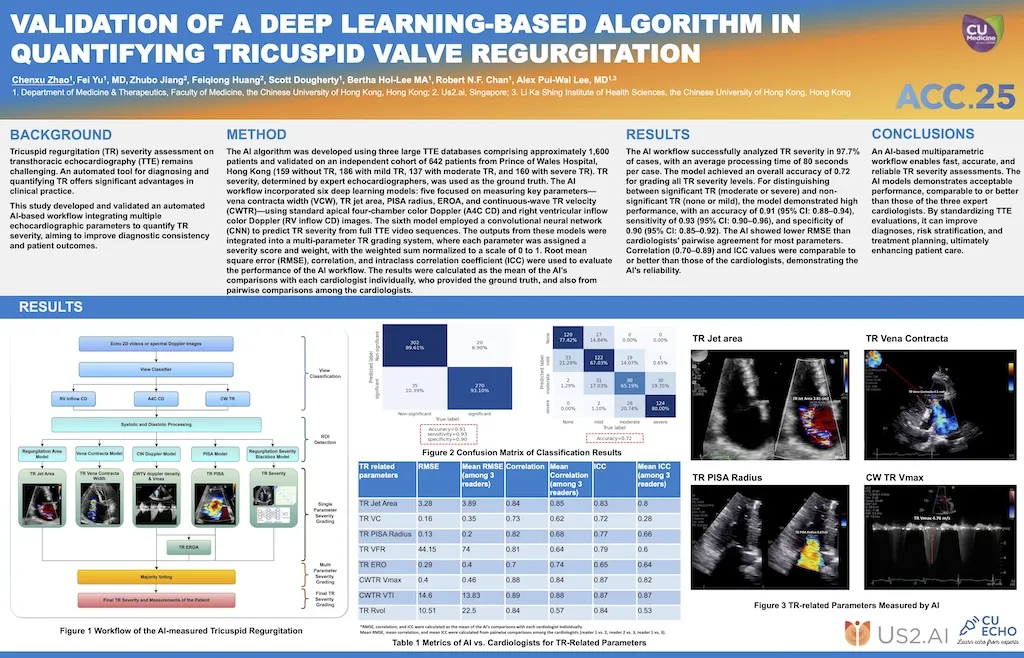
Us2.ai's latest study, presented at ACC.25 in collaboration with The Chinese University of Hong Kong, showcases the development and validation of an AI-driven workflow that integrates multiple echocardiographic parameters to quantify tricuspid regurgitation (TR) severity.
The findings demonstrate that this multiparametric AI workflow delivers fast, accurate, and reproducible TR severity assessments. Performance of the AI models was shown to be comparable to—or in some cases better than—that of three expert cardiologists.
By standardizing transthoracic echocardiographic (TTE) evaluations, the solution has the potential to enhance diagnostic accuracy, risk stratification, and clinical decision-making—marking a significant step forward in advancing precision cardiology.
Key Findings
- The AI workflow was developed on approximately 1,600 patients across 3 TTE databases and validated on an independent cohort of 642 patients from Prince of Wales Hospital, Hong Kong, spanning all TR severity categories from none to severe.
- The model successfully analysed TR severity in 97.7% of cases with an average processing time of 80 seconds per case, delivering fully automated assessments at a speed not achievable with manual echocardiographic grading.
- For the clinically critical task of distinguishing significant TR (moderate or severe) from non-significant TR, the AI achieved accuracy of 0.91, sensitivity of 0.93, and specificity of 0.90 (95% CI: 0.88-0.94, 0.90-0.96, and 0.85-0.92 respectively).
- Across key TR parameters, correlation values ranged from 0.70 to 0.89 and ICC values were comparable to or better than pairwise agreement among the 3 expert cardiologists, with AI showing lower RMSE than inter-reader disagreement for most parameters including TR jet area, CWTR Vmax, and CWTR VTI.
- The multiparametric approach integrates 6 deep learning models covering vena contracta width, TR jet area, PISA radius, EROA, continuous-wave TR velocity, and a full video-based CNN severity classifier, producing a weighted severity score on a 0 to 1 scale.
"This study demonstrates AI's transformative role in echocardiography. Our automated TR severity assessment achieves diagnostic accuracy comparable to expert cardiologists while delivering superior consistency and efficiency—setting a new standard for precision in valvular heart disease evaluation." – Prof. Alex Pui Wai Lee & Dr. Lily Zhao Li Ka Shing Institute of Health Sciences, Faculty of Medicine, The Chinese University of Hong Kong