Article | Nov 10, 2022

AI interpretation of echocardiograms – a formal validation of echo analysis software published in Nature Communications.
Key Findings
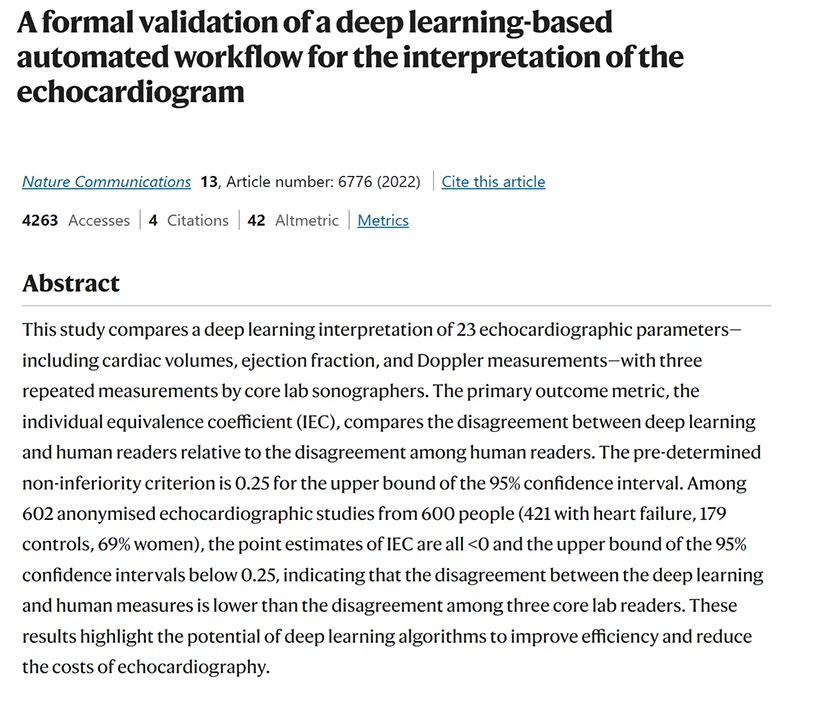
- Across 602 anonymised echocardiographic studies from 600 people (421 with heart failure, 179 controls, 69% women), IEC point estimates were all below 0 and the upper bound of all 95% confidence intervals was below the pre-determined non-inferiority threshold of 0.25, meaning AI-human disagreement was statistically lower than expert inter-reader disagreement for every single parameter.
- The study used the individual equivalence coefficient (IEC), the same rigorous statistical framework used for FDA device submissions, to formally demonstrate interchangeability rather than merely correlation, making this one of the most methodologically robust AI echo validation studies published to date.
- ICCs ranged from 0.74 for LVEF to 0.97 for interventricular septum thickness across 23 echocardiographic parameters including cardiac volumes, ejection fraction, and Doppler measurements, confirming strong agreement across the full parameter set.
- Performance was consistent across patient subgroups stratified by sex, age, hypertension, diabetes, obesity, and coronary artery disease, demonstrating generalisability beyond a narrow validation population.
- Published in Nature Communications, the study provides the scientific and regulatory foundation underpinning Us2.ai's FDA clearance and CE mark, and is cited widely as the definitive formal validation of automated echocardiographic interpretation.
Tromp, J., Bauer, D., Claggett, B. L., Frost, M. W., Iversen, M., Prasad, N., Petrie, M. C., Larson, M. G., Ezekowitz, J. A., & Solomon, S. D. (2022). A formal validation of a deep learning-based automated workflow for the interpretation of the echocardiogram. 13(1). https://doi.org/10.1038/s41467-022-34245-1