Article | Jan 21, 2024

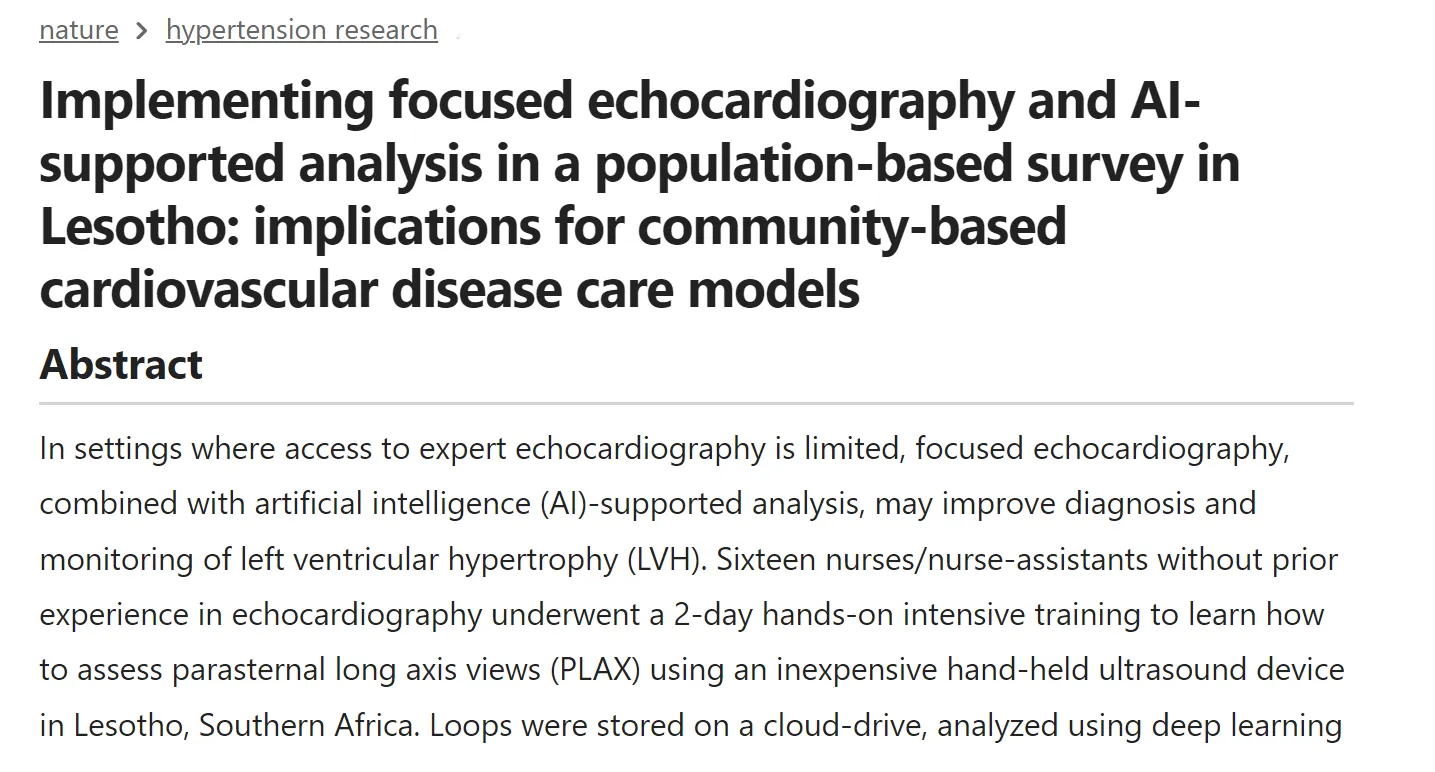
Published in Nature Hypertension Research, this study used Us2.ai to support healthcare workers in South Africa obtain LVH measurements despite limited training, hand-held sonography devices, difficult imaging conditions, and limited personal resources for analysis.
Key Findings
- 16 nurses and nurse-assistants with no prior echocardiography experience completed a 2-day hands-on training programme to acquire parasternal long axis (PLAX) views using an inexpensive handheld ultrasound device in Lesotho, demonstrating that minimal training is sufficient for task-shifting in resource-limited settings.
- The 16 trained healthcare workers obtained 756 echocardiograms across the community-based survey, with 754 successfully uploaded to cloud storage for remote AI analysis.
- Of the 754 uploaded studies, 628 (83.3%) were evaluable by Us2.ai's deep learning algorithms, and of those, 514/628 (81.9%) were confirmed by a board-certified cardiologist, showing strong agreement between AI and expert assessment despite challenging imaging conditions.
- Loops were stored on a cloud drive and analysed remotely at University Hospital Basel, demonstrating a viable telemedical workflow that decouples image acquisition from specialist interpretation across geographies with limited resources.
- The study provides proof of concept for AI-supported community cardiovascular screening in sub-Saharan Africa, where hypertension-related LVH is prevalent but access to trained sonographers and cardiologists is severely limited.
AI for remote cardiovascular care
Firima, E., Gonzalez, L., Manthabiseng, M., Bane, M., Lukau, B., Leigh, B., Kaufmann, B. A., Weisser, M., Amstutz, A., Tromp, J., Labhardt, N. D., & Burkard, T. (2024). Implementing focused echocardiography and AI-supported analysis in a population-based survey in Lesotho: implications for community-based cardiovascular disease care models. Hypertension Research, 47(3), 708-713. https://doi.org/10.1038/s41440-023-01559-6