Article | JAN 15, 2026
Pulmonary hypertension (PH) requires careful evaluation with echocardiography, but traditional manual interpretation can be time-consuming and prone to variability. This latest study demonstrates that a fully automated deep learning (DL) workflow using Us2.ai software can reliably assess PH, offering a faster, more consistent assessment.
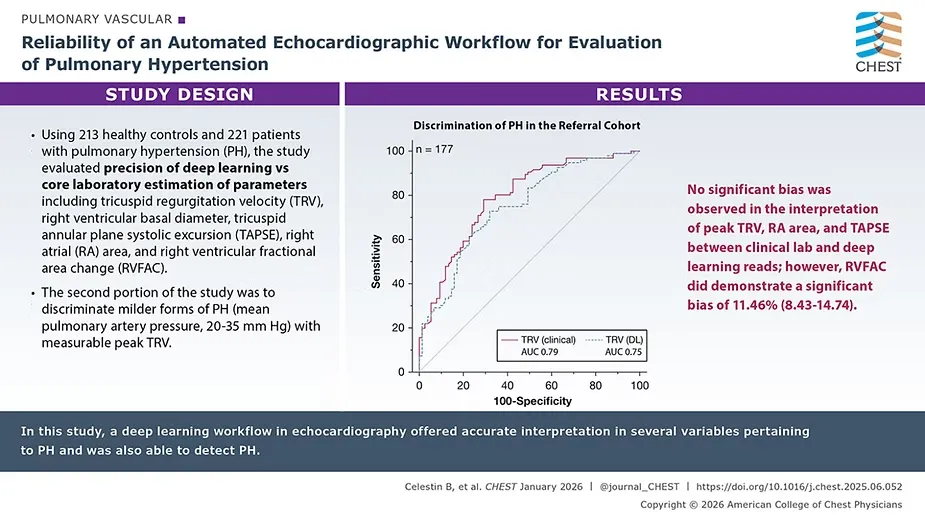
In this study, the DL system was tested against expert core laboratory reads. Results showed minimal bias in key PH measurements such as peak tricuspid regurgitation velocity (TRV), right atrial area, and tricuspid annular plane systolic excursion. Importantly, the system maintained high accuracy in detecting PH, with area under the curve (AUC) values comparable to expert readings.
These findings indicate that Us2.ai's fully automated echocardiography workflow can streamline PH assessment, reduce manual workload, and support more efficient clinical decision-making.
Key Findings
- Us2.ai achieved an AUC of 0.98 for peak TRV in distinguishing pulmonary arterial hypertension from healthy controls, matching the expert core laboratory AUC of 0.99, demonstrating near-expert diagnostic accuracy from a fully automated pipeline.
- Across the three most critical PH echo markers, the AI showed less than 2% relative bias versus expert core lab readings: peak TRV bias 0.90%, right atrial area bias 1.71%, and TAPSE bias 1.28%, all within clinically acceptable limits.
- For the harder real-world task of detecting milder PH in a referred catheterisation cohort (mean pulmonary artery pressure 20-35 mmHg), the AI achieved an AUC of 0.75 compared to 0.79 for clinical lab reads, a difference that was not statistically significant (P = .068).
- Measurement yield exceeded 90% for peak TRV and TAPSE, and the fully automated workflow required zero manual interaction, covering the complete pipeline from view classification and selection through to segmentation and measurement.
- The only parameter with significant bias was RVFAC (11.46%), highlighting an area for further refinement, while overall results support AI-driven echocardiography as a practical, scalable tool for PH assessment in clinical practice.
Celestin, B., Bagherzadeh, S. P., Santana, E., Frost, M., Iversen, M., Hermansson, F. N., Sweatt, A., Zamanian, R. T., Hummel, Y. M., Rendon, Gabriela. Gomez., Yen, J., Sandros, M., Salerno, M., & Haddad, F. (2025). Artificial Intelligence-Based Echocardiography in Pulmonary Arterial Hypertension. CHEST. https://doi.org/10.1016/j.chest.2025.06.052