Overview
Detection of disease progression is critical to personalising treatment strategies in transthyretin cardiomyopathy, particularly with the emergence of new disease-modifying therapies. While serial echocardiography is a promising and accessible monitoring tool, its utility in practice is limited by operator dependence and measurement variability. Even subtle changes in echocardiographic parameters have prognostic significance in ATTR-CM, yet manual measurements performed by different operators may lack the precision to reliably detect these changes in routine care.
AI-based echocardiographic analysis offers the potential to minimise measurement variability and improve the precision of serial assessments. This study evaluated the agreement and repeatability of fully automated Us2.ai measurements under real-world conditions in a longitudinal ATTR-CM cohort, comparing performance against an experienced reference reader, a second cardiologist, and a novice reader.
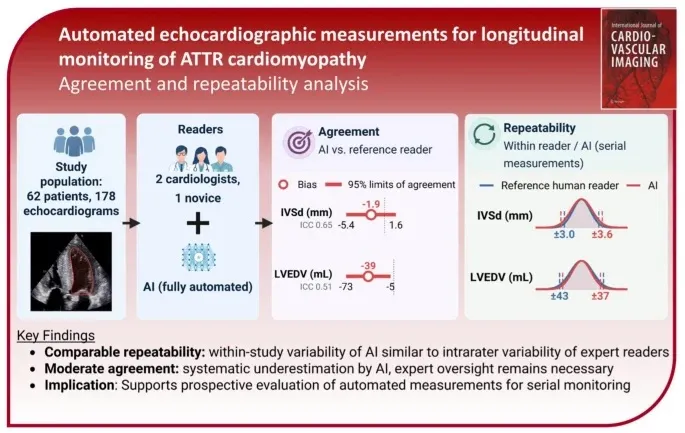
Study Design
This retrospective longitudinal cohort study included 62 patients with ATTR-CM from the University Hospital Zurich Amyloidosis Registry, undergoing a total of 178 serial annual echocardiograms. Ninety percent of patients were male with a median age of 73 years. Thirty-four percent were treated with TTR-modifying therapy at baseline.
All echocardiograms were analysed by four raters: Us2.ai's fully automated algorithm, an experienced board-certified cardiologist serving as the reference human reader, a recently board-certified cardiologist, and a novice medical student with approximately 12 hours of training. Key parameters assessed included interventricular septal thickness in diastole (IVSd), posterior wall thickness in diastole, LV end-diastolic and end-systolic volumes, LVEF, and E/e' ratio.
Interrater agreement was assessed using Bland-Altman analysis and intraclass correlation coefficients. Intrarater variability for human readers was derived from repeated blinded measurements, with limits of agreement defining the minimal detectable change. AI repeatability was assessed using within-study automated pipeline variability across available acquisitions, deliberately accepted to mirror real-world conditions where specific acquisition documentation is not systematic.
Key Results
AI Agreement with Reference Human Reader:
- Moderate agreement for IVSd (ICC 0.65), LV volumes (ICC 0.51 for LVEDV), LVEF (ICC 0.62), and stroke volume (ICC 0.61)
- Good agreement for PWd (ICC 0.81) and E/e' ratio (ICC 0.76)
- Mean biases of -1.9 mm for IVSd, -39 mL for LVEDV, and +6% for LVEF
AI Repeatability vs. Human Intrarater Variability:
- AI within-study limits of agreement were 3.6 mm for IVSd and 37 mL for LVEDV
- Reference human reader intrarater limits of agreement were 3.0 mm for IVSd and 43 mL for LVEDV
- AI repeatability was numerically comparable to that of experienced cardiologists and substantially better than the novice reader (LoA 5.1 mm for IVSd and 61 mL for LVEDV)
Longitudinal Assessment:
- Annual changes were minimal across all raters, with median changes close to zero for wall thickness parameters
- Standard deviation of annual changes was comparable across all raters, with a trend towards lower variability for AI in volume parameters
- Bias of annual change scores was small for all raters, with the systematic volume underestimation seen in absolute AI measurements largely absent in longitudinal change analysis
Why This Matters
Reliable detection of subtle disease progression in ATTR-CM is one of the most clinically challenging aspects of managing this condition, particularly as more therapeutic options become available and the ability to identify treatment response early becomes increasingly important. This study demonstrates that Us2.ai's within-study repeatability is comparable to that of experienced human readers, which is a necessary prerequisite for a tool capable of detecting real longitudinal change rather than measurement noise.
The authors note that while moderate agreement in absolute measurements indicates that expert oversight remains necessary, the low within-study variability of AI-derived measurements suggests it could provide a consistent and reproducible basis for serial assessments. This is particularly relevant in real-world settings where multiple operators perform and measure echocardiograms over time, where human interobserver variability is an established limitation.
Conclusion
Fully automated Us2.ai measurements showed within-study repeatability of similar magnitude to the intrarater variability of experienced human readers in a longitudinal ATTR-CM cohort, supporting further prospective evaluation for serial echocardiographic assessment. Agreement in absolute terms was moderate for wall thickness and LV volumes, indicating that expert oversight remains necessary in advanced disease. Together, the findings position AI-assisted echocardiography as a candidate tool for standardising longitudinal monitoring in ATTR-CM as the therapeutic landscape continues to evolve.
Walser, A., Clerc, O. F., Mork, C., Flammer, A. J., Myhre, P. L., Schwotzer, R., Gräni, C., Ruschitzka, F., Tanner, F. C., & Benz, D. C. (2026). Automated echocardiographic measurements for longitudinal monitoring of ATTR cardiomyopathy: agreement and repeatability analysis. The International Journal of Cardiovascular Imaging. https://doi.org/10.1007/s10554-026-03835-1