Overview
Deep learning algorithms for automated echocardiographic measurements have demonstrated strong performance in adult populations, but their utility in paediatric echocardiography had remained unclear. Children present unique challenges for automated analysis, including differences in cardiac geometry, heart rate, and body surface area compared to adult populations. Childhood cancer survivors represent a particularly important group for serial cardiac monitoring, given their elevated risk of cardiotoxicity from anthracycline chemotherapy and chest radiotherapy.
This study provides the first independent validation of Us2.ai in a paediatric population, evaluating agreement between the FDA-cleared automated software and gold-standard core laboratory measurements across a multicenter dataset of childhood cancer survivors.
Study Design
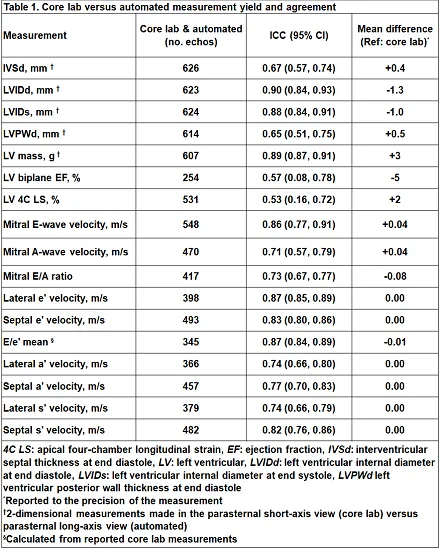
This retrospective study analysed echocardiogram DICOM files from five paediatric centres alongside corresponding core laboratory measurements collected from childhood cancer survivors under 21 years of age. A total of 652 echocardiograms from 153 patients were included. Median age at the time of study was 13.4 years (IQR 9.5 to 16.3). Sixteen percent of studies showed depressed LV systolic function by core laboratory measurements. Agreement between Us2.ai and core laboratory measurements was assessed for 17 two-dimensional and Doppler measurements using mean difference and intraclass correlation coefficient.
Key Results
- Agreement was at least moderate (ICC above 0.5) across all 17 variables assessed
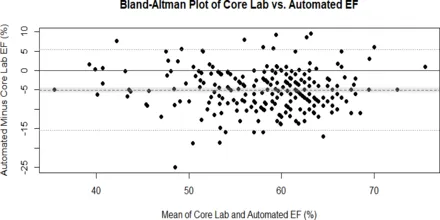
- On average, Us2.ai underestimated biplane ejection fraction by 5 percentage points compared to the core laboratory reader
- Mean differences varied by EF range: -1 percentage point for core lab EF at or below 50%, and -5 percentage points for EF above 50%
- ICC for ejection fraction was comparable to previously reported interobserver variability among human paediatric readers, indicating the level of agreement is within clinically acceptable bounds
Why This Matters
Childhood cancer survivors require lifelong cardiac surveillance due to the cardiotoxic effects of many cancer treatments. This monitoring is often resource-intensive, requiring serial echocardiograms interpreted by paediatric cardiology specialists who are not universally available across all centres. Automated echocardiographic analysis has the potential to standardise measurements, reduce variability between readers, and support higher-volume monitoring programmes.
This study demonstrates that Us2.ai, developed and validated primarily in adult populations, achieves at least moderate agreement with expert core laboratory measurements across all parameters in a paediatric cohort, including in studies with depressed LV function. The observed EF bias is consistent with known differences between automated and manual measurement approaches and falls within the range of interobserver variability reported between human paediatric readers, supporting clinical acceptability.
As the first independent validation of Us2.ai in a paediatric population, these findings open an important new area of application for AI-assisted echocardiography and lay the groundwork for future prospective studies in this patient group.
Conclusion
Independent validation of Us2.ai in a paediatric dataset of childhood cancer survivors demonstrated at least moderate agreement with gold-standard core laboratory measurements across all echocardiographic parameters assessed. These findings support the potential utility of AI-assisted echocardiographic analysis in paediatric cardiac surveillance and represent an important first step toward broader validation in this population.
Edwards L, Sharma S, Armenian S, Bhat A, Blythe N, Border W, Boyle P, Leger K, Leisenring W, Meacham L, Nathan P, Narasimhan S, Sachdeva R, Sadak K, Stratton K, Vemulapalli S, Chow E. Abstract 4368616: Core lab versus computer: Pediatric echocardiogram measurement agreement between expert human and AI readers. Circulation. 2025;152(Suppl_3). https://doi.org/10.1161/circ.152.suppl_3.4368616