Overview
Artificial intelligence has emerged as a promising tool for echocardiographic image analysis, with the potential to improve efficiency and reduce interobserver variability. However, real-world comparisons between AI-based analysis and human expert interpretation, and crucially their correlation with clinical outcomes, remain limited. This study addressed that gap directly, evaluating whether Us2.ai-derived echocardiographic measurements correlate with human expert interpretation and whether they perform comparably in predicting one-year mortality in a real-world hospitalized population.
Study Design
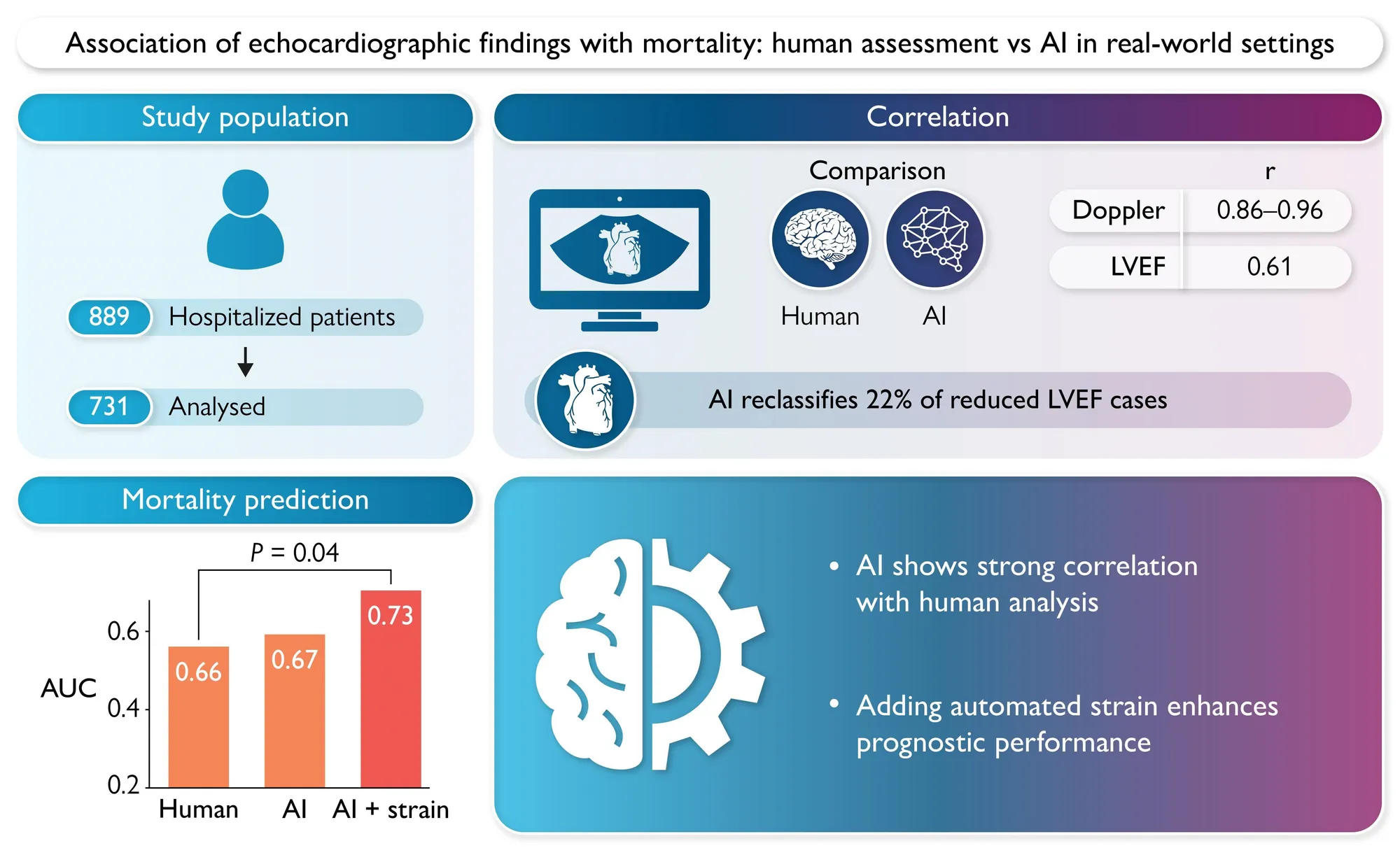
This retrospective study analysed 889 consecutive hospitalized patients who underwent a clinically indicated echocardiographic examination at Tel Aviv Sourasky Medical Center. All studies were independently read and analysed by both human echocardiographic experts and Us2.ai. Of the 889 patients, 731 had sufficient echocardiographic data for inclusion in the final analysis. The mean age was 68 years, 46% were female, and the cohort represented a typical real-world hospitalized population with a broad range of cardiac conditions.
Correlation analysis was performed for common echocardiographic variables obtained by human versus AI assessment. Multivariable models were then compared for their ability to predict one-year all-cause mortality, with and without AI-derived left ventricular strain analysis.
Key Results
Measurement Agreement:
- Most echocardiographic parameters showed strong correlation between human and AI-derived measurements
- AI-derived LVEF values were significantly higher than human estimates, with a mean difference of 5.8% (p<0.001)
Mortality Prediction:
- In a multivariable model, AI-based and human-based mortality prediction were comparable (AUC 0.67 vs. 0.66, p=0.86)
- When AI-obtained automated left ventricular strain analysis was incorporated, the AI-based model was superior to human assessment in predicting one-year mortality (AUC 0.73 vs. 0.66, p=0.048)
Why This Matters
This study provides important real-world evidence that Us2.ai-derived measurements are not only strongly correlated with expert human assessments but are clinically meaningful in terms of prognostic value. The comparability of AI and human mortality prediction models confirms that automated analysis can serve as a reliable alternative to manual measurement in a busy clinical setting.
The finding that incorporating AI-derived LV strain analysis improved mortality prediction beyond what human assessment alone could achieve is particularly significant. LV strain is a parameter that requires advanced expertise and time to measure manually, making it one of the parameters least likely to be consistently obtained in routine clinical practice. The ability of Us2.ai to automate this measurement and add prognostic value highlights a practical clinical benefit of AI-assisted echocardiography that goes beyond workflow efficiency.
Conclusion
Us2.ai-based echocardiographic analysis shows strong correlation with human expert measurements and comparable mortality prediction in hospitalized patients. When AI-derived LV strain analysis is included, the model outperforms human assessment in predicting one-year mortality, supporting the potential of AI-assisted echocardiography to enhance both clinical efficiency and prognostic accuracy in real-world practice.
Merin, R., Perelman Moran, G., Merin, H., Tzuberi, M., Banai, S., Stsiapanava, E., Topilsky, Y., & Nir, F. (2026). Association of echocardiographic findings with mortality: human assessment vs. automated deep learning analysis. European Heart Journal - Digital Health, 7(2). https://doi.org/10.1093/ehjdh/ztaf148