Professor Carolyn S.P. Lam, co-founder of Us2.ai, senior consultant cardiologist at the National Heart Centre Singapore, and tenured full professor at Duke-NUS Medical School, was featured this week in a Q&A published by Med (Cell Press).
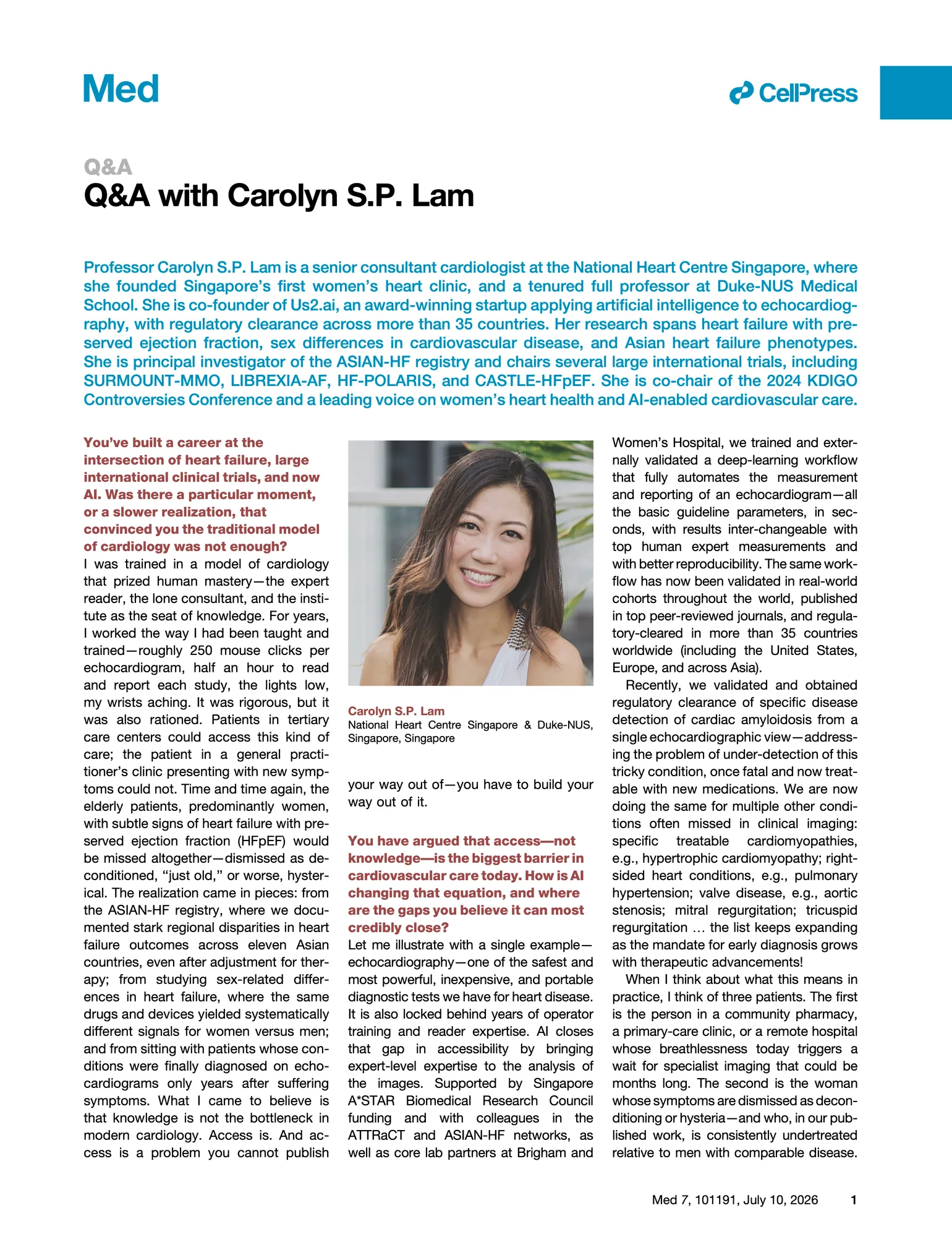
The conversation spans her career at the intersection of heart failure, large international clinical trials, and artificial intelligence, and sets out a clear thesis for where AI in cardiology should be heading.
Reflecting on years of reading echocardiograms by hand, roughly 250 mouse clicks per study and half an hour per report, Professor Lam describes the moment the traditional model of cardiology stopped feeling like enough. The ASIAN-HF registry showed stark regional disparities across eleven countries. Sex-difference research showed the same drugs and devices producing systematically different signals for women. Elderly patients, predominantly women, with subtle signs of heart failure with preserved ejection fraction (HFpEF) were consistently missed, dismissed as deconditioned or "just old."
"Knowledge is not the bottleneck in modern cardiology," she writes. "Access is. And access is a problem you cannot publish your way out of. You have to build your way out of it."
The Q&A traces how that conviction shaped Us2.ai: a fully automated echocardiographic measurement and reporting workflow, externally validated in real-world cohorts, published in leading peer-reviewed journals, and regulatory-cleared in more than 35 countries including the United States, Europe, and across Asia. It also covers the company's recent regulatory clearance for AI-based detection of cardiac amyloidosis from a single echocardiographic view, and the growing pipeline of disease detection modules for conditions that remain under-diagnosed today, including hypertrophic cardiomyopathy, pulmonary hypertension, aortic stenosis, mitral regurgitation, and tricuspid regurgitation.
A model that performs on a retrospective dataset, she notes, is "at best, a hypothesis." A model that is prospectively externally validated, regulatory-cleared, embedded in real clinical workflow, and audited in routine use is a tool. Most of the work that matters, she argues, happens in the gap between the two.
The Q&A also highlights the ongoing multi-national community-based screening programs Us2.ai technology is enabling, including the CAPTURE-HFpEF study in Denmark (NCT07493590) and the SYMPHONY-HF trial (NCT05919342).
Professor Lam closes with a challenge to the field: "If we treat AI as a cost-cutting tool, we will get a cheaper version of the system we already have. If we treat it as an equity tool, we will get something genuinely new: care that scales with need, not with privilege."
Read the full Q&A in Med (Cell Press) →