Overview
Heart disease is a leading cause of death for American Indians, who face barriers to diagnosis and cardiac care, particularly in rural areas. This abstract describes a program in one Arizona tribe in which Community Health Representatives (CHRs) perform point-of-care screening echocardiography with AI-assisted interpretation (POCSE-AI). It follows the curriculum design presented at AHA 2025 and the program overview presented at ASE 2025, and reports the first deployment results along with a Training-of-Trainers (TOT) model for local mentorship.
Study Design
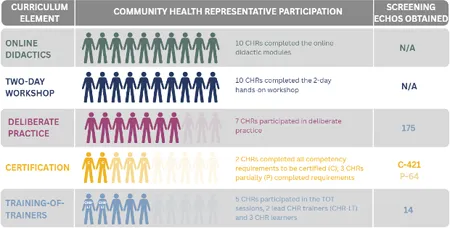
The training curriculum had three parts: online didactics, a hands-on workshop, and six months of deliberate practice with in-person expert mentorship. To certify, a CHR had to pass a professional skills exam in a simulated patient encounter and submit studies they had acquired independently that met AI-confirmed diagnostic image quality standards.
Certified CHRs scanned on tribal lands at organized screening events. A case manager led the cardiology referral process, which had two routes. Abnormal POCSE-AI studies were referred for confirmatory echocardiography, and predefined borderline findings went to remote cardiologist image review.
The TOT model aimed to promote certified CHRs to lead CHR trainers (CHR-LT) who could mentor learner CHRs at the bedside. TOT sessions included physician-led teaching on adult education theory, followed by a day of structured scanning with volunteer patients. Afterward, the CHR-LTs completed questionnaires assessing their ability to mentor at the bedside, reduce learner cognitive load, and create an adult learning environment.
Key Results
- Ten CHRs began the curriculum (80% female, median age 52 years, IQR 50 to 60). None had prior ultrasound training, and two achieved certification.
- Over 14 months, 485 POCSE-AI studies were completed at 6 community locations, 285 (59%) of them at the CHR office echo lab.
- Patients had an average age of 45 years (IQR 36 to 60), and 60% were female.
- Of the patients screened, 111 (23%) were referred for confirmatory echocardiography because of an abnormal POCSE-AI study.
- Of 65 borderline studies, 53 (78%) were reclassified as normal and 12 (18%) were referred for confirmatory echocardiography.
- Seven people took part in the TOT sessions: 3 learner CHRs, 2 CHR-LTs, 1 physician and 1 cardiac sonographer instructor. Both CHR-LTs strongly agreed that they had improved in all three mentoring competencies, based on self-assessment.
- In the following 3 months, the 2 CHR-LTs conducted 14 mentored studies with 2 learner CHRs, and 1 learner left the CHR program. No new CHRs have been certified to scan independently to date.
Why This Matters
Screening echocardiography usually depends on trained sonographers, who are scarce in rural and tribal communities. This program tested whether local health workers with no ultrasound background could acquire diagnostic-quality studies with AI support, and whether certified CHRs could then train others. Certification was the limiting step in this cohort, and the authors identify it as the area that needs further work.
Conclusion
The authors conclude that a competency-based model can train novice learners and deploy POCSE-AI in underserved rural communities. The TOT model was feasible and supported community mentorship, but further interventions are needed to increase CHR certification. Ongoing work focuses on optimizing the referral pathway and giving CHRs image quality feedback for continuing medical education.
Riley, A., Yadava, M., Thoroughman, R., Adams, D. B., Krupowies, N., & De Loizaga, S. (2026). Abstract 14646: Strengthening Community Health representative capacity for AI-Assisted screening echocardiography in a rural American Indian community. Circulation, 154(Suppl_1). https://doi.org/10.1161/circ.154.suppl_1.14646