Overview
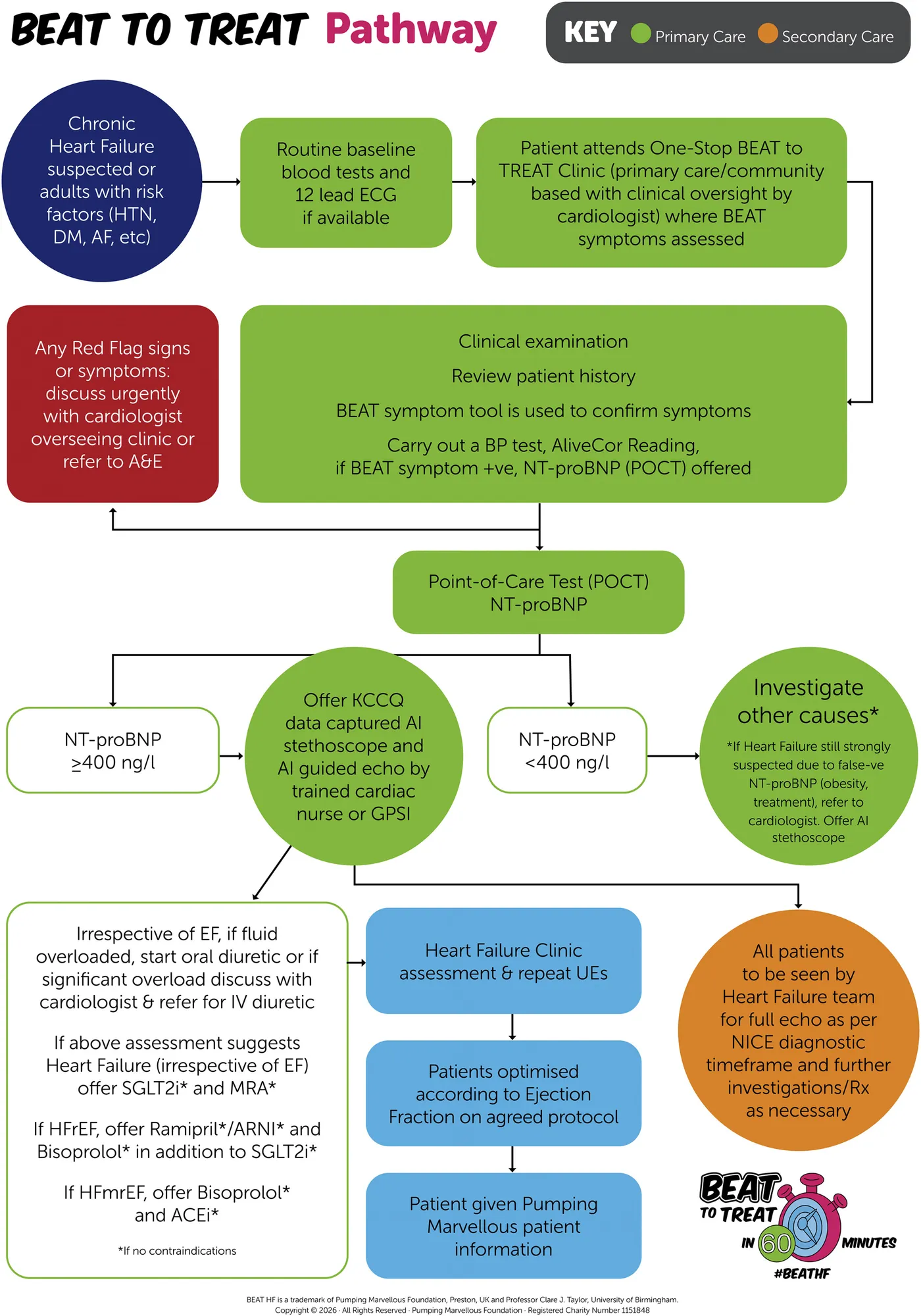
Delayed diagnosis is common in heart failure, and many patients first receive a diagnosis during an emergency admission, after opportunities to start guideline-directed medical therapy (GDMT) have been missed. These barriers are greater in socioeconomically deprived populations. This brief report describes the first implementation of the "BEAT to Treat" pathway at a one-stop community testing event. The pathway combines AI-assisted echocardiography, point-of-care biomarker testing and immediate treatment initiation. It builds on earlier BEAT-HF community events, including the Everton BEAT-Breathlessness Community Hub.
Study Design
The event took place on March 6, 2026, in Speke, South Liverpool, an area within the 10% most deprived communities in England. Adults were invited through text messages, social media and community engagement, with a focus on people aged 40 years or older or with cardiovascular risk factors such as hypertension or diabetes. A multidisciplinary team of primary care clinicians, secondary care clinicians, trained volunteers and preventive health services delivered the event.
Participants completed a BEAT symptom assessment, blood pressure measurement and a 30-second 6-lead ECG for atrial fibrillation (AF). Those with an elevated finger-stick NT-proBNP (400 ng/L, per NICE thresholds) had a clinical examination and point-of-care AI-assisted echocardiography. A trained heart failure specialist nurse or general practitioner performed the scan with a Vscan Air (GE Healthcare), with AI reporting by Us2.ai. A consultant cardiologist also vetted the images. The echocardiographic protocol included AI-automated assessment of chamber dimensions, ventricular structure, and systolic and diastolic function, along with Us2.ai's pattern recognition for cardiac amyloidosis. GDMT was started at the point of diagnosis, and follow-up was arranged with the cardiology team.
The primary outcomes were new heart failure diagnoses, classified by phenotype, and new AF diagnoses. Secondary outcomes included immediate GDMT initiation, escalation of care, detection of cardiovascular risk factors and engagement with preventive services.
Key Results
- 376 people attended. The median age was 67 years (range, 24 to 92), 47% were women, 11% were aged 80 years or older and about 10% were from non-White ethnic backgrounds.
- Elevated blood pressure was identified in 43% of attendees.
- Seven new cases of AF were identified (1.9%), and anticoagulation was started immediately in all eligible participants.
- Twenty-four participants had point-of-care NT-proBNP testing and 12 had AI-assisted echocardiography.
- Ten new heart failure diagnoses were made (2.7%): 7 with preserved ejection fraction, 2 with reduced ejection fraction and 1 with mildly reduced ejection fraction.
- Two participants with preserved ejection fraction had features raising suspicion of transthyretin cardiac amyloidosis, based on AI pattern recognition, and were referred for specialist evaluation.
- GDMT was started at the point of diagnosis. One participant with NYHA class III symptoms, marked fluid overload and new AF was escalated the same day to a remotely monitored virtual ward for home intravenous diuretics, which the authors say likely prevented an emergency admission.
- Participants also engaged with co-located preventive services, including 86 engagements with Smokefree Liverpool, 47 with The Life Rooms, 15 NHS Diabetes Prevention Programme referrals, 16 abdominal aortic aneurysm screening engagements and 11 Type 2 Diabetes Path to Remission referrals.
Why This Matters
Access to formal echocardiography can be limited by geography, deprivation and service capacity. In this report, AI-assisted point-of-care echocardiography allowed imaging to take place in a non-hospital setting with specialist oversight, so diagnosis and treatment could happen in a single encounter. The authors suggest that AI-enabled community services could help reduce inequities in diagnosis and treatment.
Conclusion
The authors conclude that the BEAT to Treat model is feasible within a community screening event, identified previously undiagnosed heart failure and AF, enabled same-day initiation of therapy, and linked participants to preventive services. They state that larger prospective studies should evaluate clinical outcomes, sustainability, economic impact and scalability.
Sankaranarayanan, R., Hartshorne-Evans, N., Hornby, K., Clark, A., Rooke, G., Knott, S., Watkins, F., Ashton, M., & Lam, C. S. P. (2026). BEAT to treat: Artificial intelligence−enabled point-of-care diagnostics for community-based detection and immediate management of heart failure in a socioeconomically deprived UK population. Journal of Cardiac Failure, 32(11), 2040–2044. https://doi.org/10.1016/j.cardfail.2026.08.017